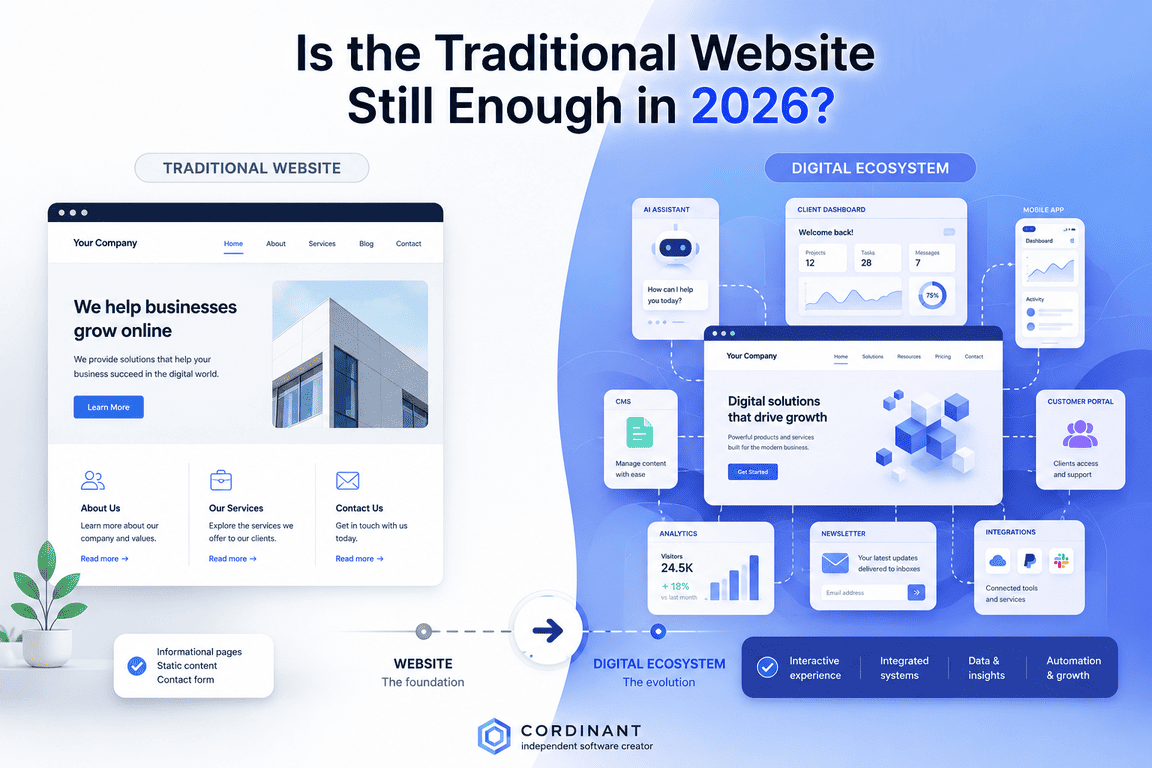
There was a time when launching a business online followed a fairly predictable pattern. You bought a domain, hired someone to design a website, added a few pages describing your services, published a contact form, and considered your digital presence complete. For many companies, that really was enough. The website acted as an online brochure, helping potential customers learn who you were and how to get in touch.
That approach hasn't disappeared. Plenty of businesses still operate successfully with relatively simple websites. Yet the question feels more interesting today than it did even a few years ago. Not because websites have become obsolete, but because the internet around them has changed so dramatically.
When people ask whether websites are still relevant, they are often asking the wrong question. Websites are everywhere and remain one of the foundations of the web. The more useful question is whether a traditional website can still meet the expectations of customers, search engines and businesses in 2026.
A website hasn't become less important. In many cases, it has simply become one part of a much larger digital ecosystem.
The Meaning of "Traditional Website" Has Barely Changed
The phrase traditional website doesn't refer to old technology. It describes a certain way of thinking about an online presence. Typically, these websites consist of several static pages: a homepage, an about page, a list of services, perhaps a gallery, and a contact page. Content changes infrequently, visitors mainly consume information, and interaction is limited to sending an enquiry or making a phone call.
There is absolutely nothing wrong with that model. In fact, it remains entirely appropriate for many local businesses, consultants, restaurants, photographers and small companies whose primary goal is simply to be discoverable online.
The challenge is that many businesses now expect their websites to do far more than introduce the company.
When Websites Became Products
One trend that has become increasingly noticeable is the gradual shift from websites acting as digital brochures to becoming products in their own right.
A growing number of businesses no longer separate their website from their service. Customer dashboards, booking systems, online learning platforms, member areas, client portals, knowledge bases, calculators, AI-powered tools and interactive configurators all live behind what still appears, from the outside, to be "a website."
The line between a website and a web application has become increasingly difficult to draw. Many modern businesses operate somewhere between the two.
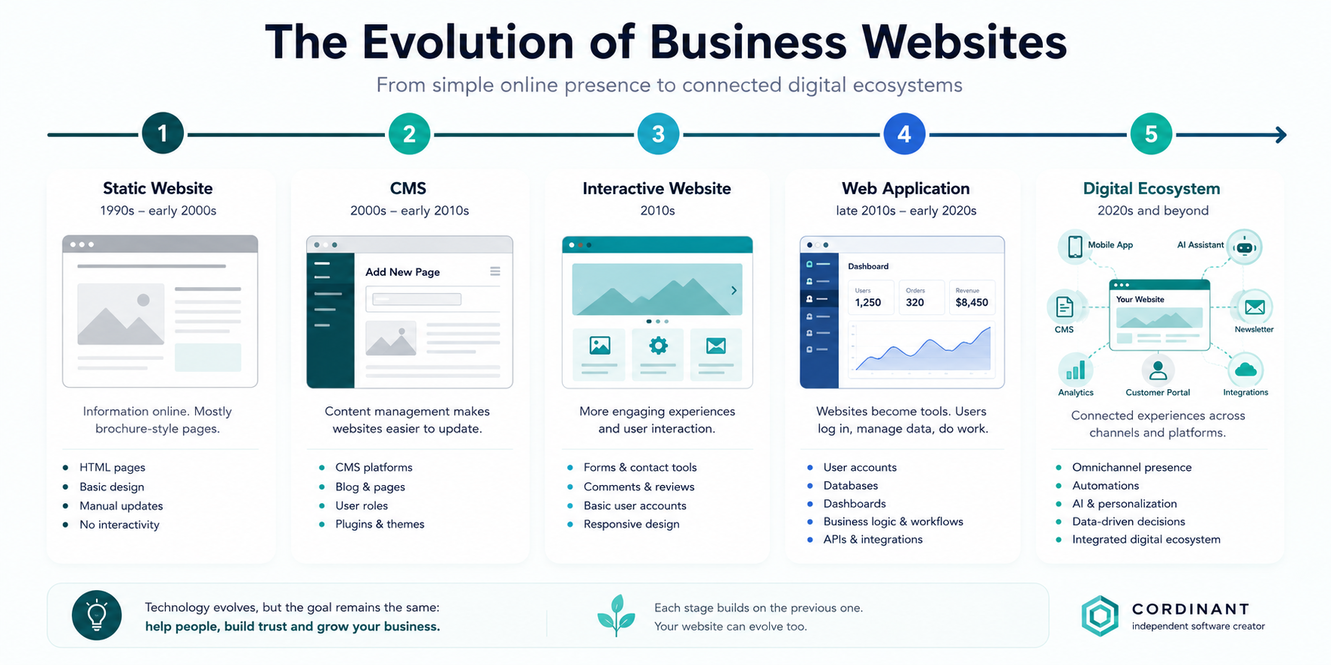
Not every company needs a complex web application. The interesting change is that many businesses now expect their websites to actively support daily operations rather than simply describe them.
Building Cordinant Changed How I Think About Websites
Working on Cordinant gradually changed the way I look at websites. When I first started planning the project, I imagined it primarily as a place to present products. Over time, it became obvious that almost every new idea affected several different parts of the system.
Writing a blog article meant thinking about SEO metadata, categories, related articles and internal links. Adding a new product required screenshots, documentation, licensing information, downloads and structured content. Even something as simple as publishing an article involved an admin interface, media management and a content model behind the scenes.
At some point I realised I was spending as much time building the systems behind the website as I was designing the pages visitors actually see.
That experience is specific to my own project, but it reflects a broader pattern. Many websites today depend on administration tools, databases, automation, integrations and workflows that remain completely invisible to visitors.
The Internet Around Websites Has Changed
Perhaps the biggest difference isn't the website itself but everything surrounding it.
Search engines are evolving. AI assistants increasingly answer questions directly. Social platforms compete for attention. Newsletters build communities independently of search traffic. Video often reaches audiences that would never discover a written article. Businesses communicate through messaging platforms, mobile apps and online communities alongside their websites.
The website hasn't disappeared from this picture. Instead, it has become one destination among many.
That shift raises an interesting question. If people first encounter a company through AI search, social media, YouTube or a newsletter, what should the website actually do when they finally arrive?
Answering that question turns out to be much more complicated than simply deciding how many pages a website should have. In many cases, it changes how the entire digital presence is planned from the beginning.
In the next part, we'll look at why customer expectations, AI, search behaviour and modern business workflows are pushing many companies beyond the limits of the traditional website—and why that doesn't necessarily mean every business needs a full web application.
Visitors Expect to Do Something, Not Just Read
One of the biggest changes over the past decade is that people increasingly expect websites to help them accomplish something. Reading information is still important, but it is often only the first step.
A visitor might want to book an appointment, compare products, calculate soft costs, track an order, download a file, access an account, customise a service or speak to an AI assistant. In many cases, simply presenting information no longer feels sufficient because users have become accustomed to interacting with digital services rather than passively consuming content.
This shift didn't happen overnight. It emerged gradually as online banking, e-commerce, streaming platforms and countless web applications became part of everyday life. Once people become familiar with interactive experiences, those expectations naturally influence how they judge every other website they visit.
The question is no longer "Can visitors find the information?" More often, it is "Can visitors achieve what they came here to do?"
Search Is No Longer the Only Way People Discover Websites
For many years, websites relied heavily on search engines. A potential customer typed a query into Google, compared several results and clicked through to a company's website. That journey still exists, but it is no longer the only path—or even the most common one for some businesses.
People now discover companies through YouTube videos, LinkedIn posts, Reddit discussions, newsletters, podcasts, online communities and social media. Increasingly, AI-powered search tools summarise information before users even visit the original source.
That doesn't necessarily reduce the importance of having a website. Instead, it changes its role. Rather than being the place where people first hear about a business, it often becomes the place where they decide whether that business is credible.
In other words, the website has become a destination for verification as much as discovery.
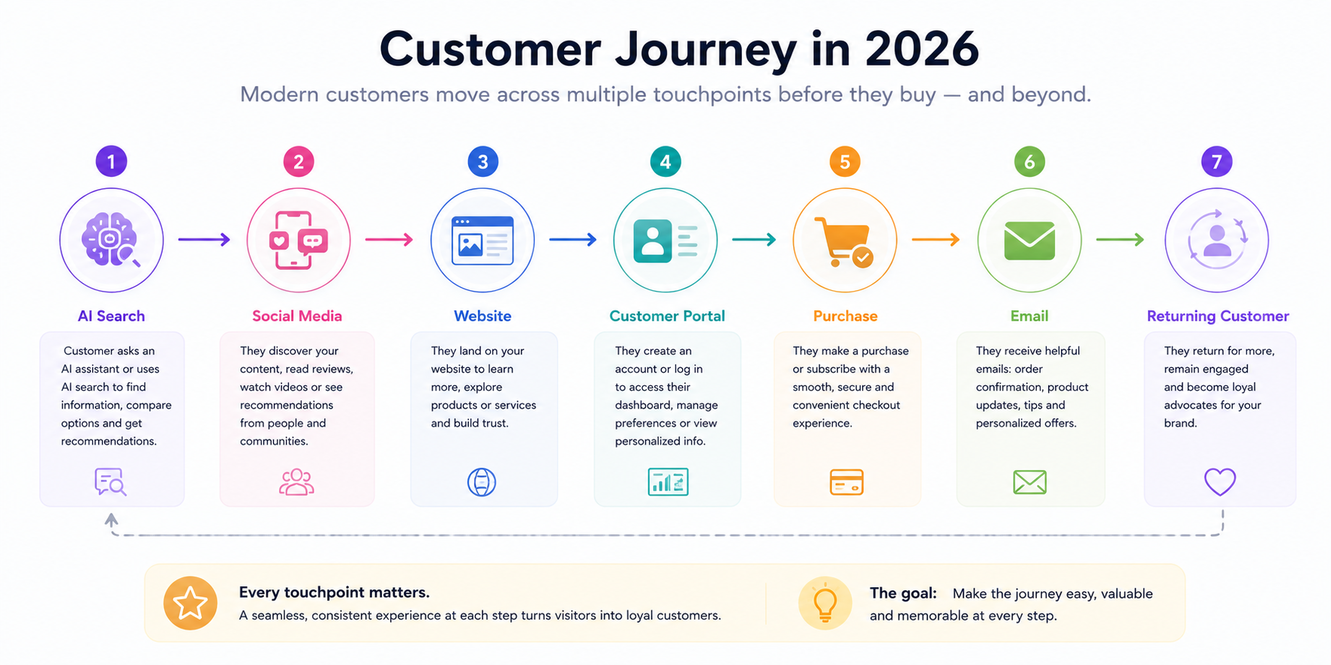
Even when visitors arrive from AI search, social media or recommendations, they often expect the website to provide the most complete, trustworthy and up-to-date information.
Content Has Become Part of the Product
Many businesses once treated their websites and their marketing as separate activities. The website existed, while content was something occasionally added to improve search rankings.
Today the relationship is much closer. Articles explain products, documentation supports customers, comparison pages answer common questions and case studies demonstrate how a service is used in practice. Sometimes this content generates more long-term value than advertising campaigns that disappear after a few weeks.
While building Cordinant, I noticed that writing an article rarely ended with pressing the publish button. Each article became connected to product pages, categories, internal links, metadata, images and future topics. Over time, the blog stopped feeling like an optional extra and became another important part of the website itself.
This probably isn't unique to my project. Many companies now build knowledge bases, documentation libraries and resource centres that continue attracting visitors long after they are published.
AI Is Changing Expectations Without Replacing Websites
Artificial intelligence has introduced another layer to this discussion. Some headlines suggest that AI assistants will replace websites entirely, while others predict the end of traditional search. Reality seems more complicated.
AI can summarise information, answer questions and recommend products, but it still needs reliable sources. Company websites remain one of those sources. Product specifications, documentation, pricing, policies and original articles all need somewhere to exist before they can be discovered, indexed or referenced.
At the same time, AI is influencing what visitors expect after they arrive. Instant answers, conversational interfaces, personalised recommendations and intelligent search are becoming increasingly familiar experiences. Businesses don't necessarily need to implement every new feature, but user expectations continue to evolve regardless.
Adding AI features simply because they are fashionable rarely improves a website. The more useful question is whether they solve a real problem for visitors or make an existing task noticeably easier.
Behind Many Modern Websites Is a Growing Collection of Systems
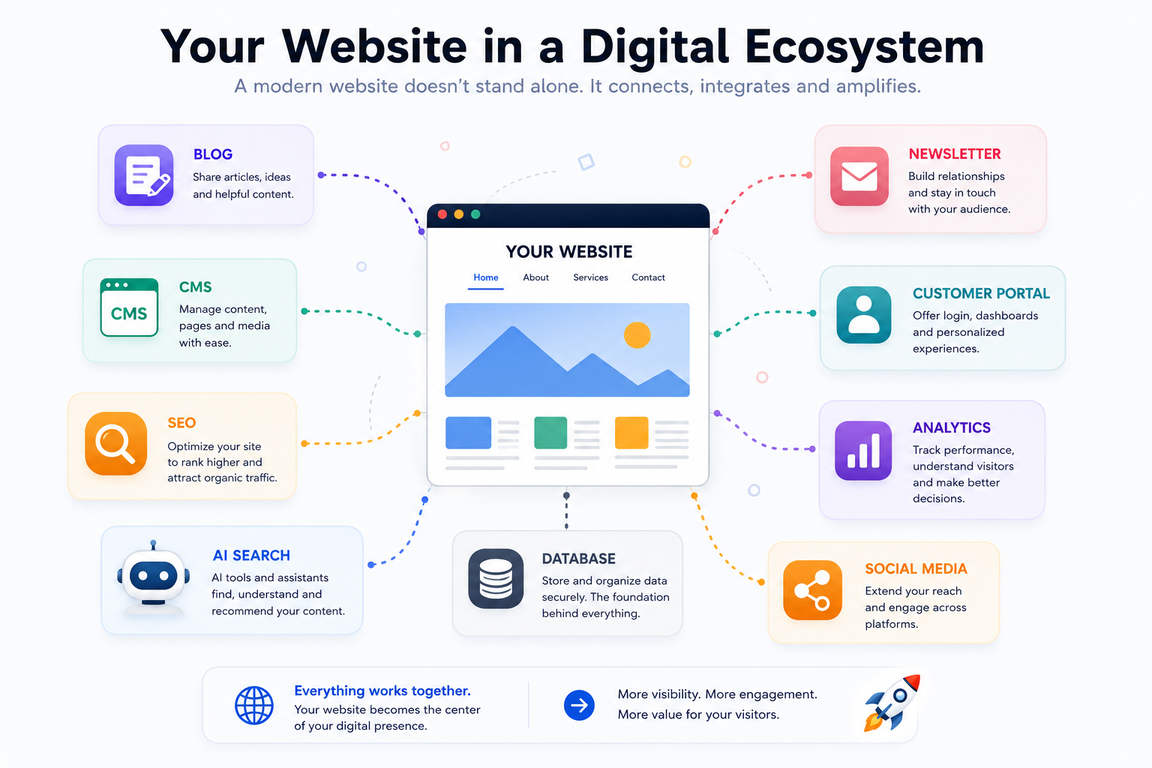
Looking at a finished homepage rarely reveals how much software is working behind it. Content management systems, databases, analytics, email platforms, payment gateways, automation tools, search indexes and media libraries often operate together without visitors ever noticing.
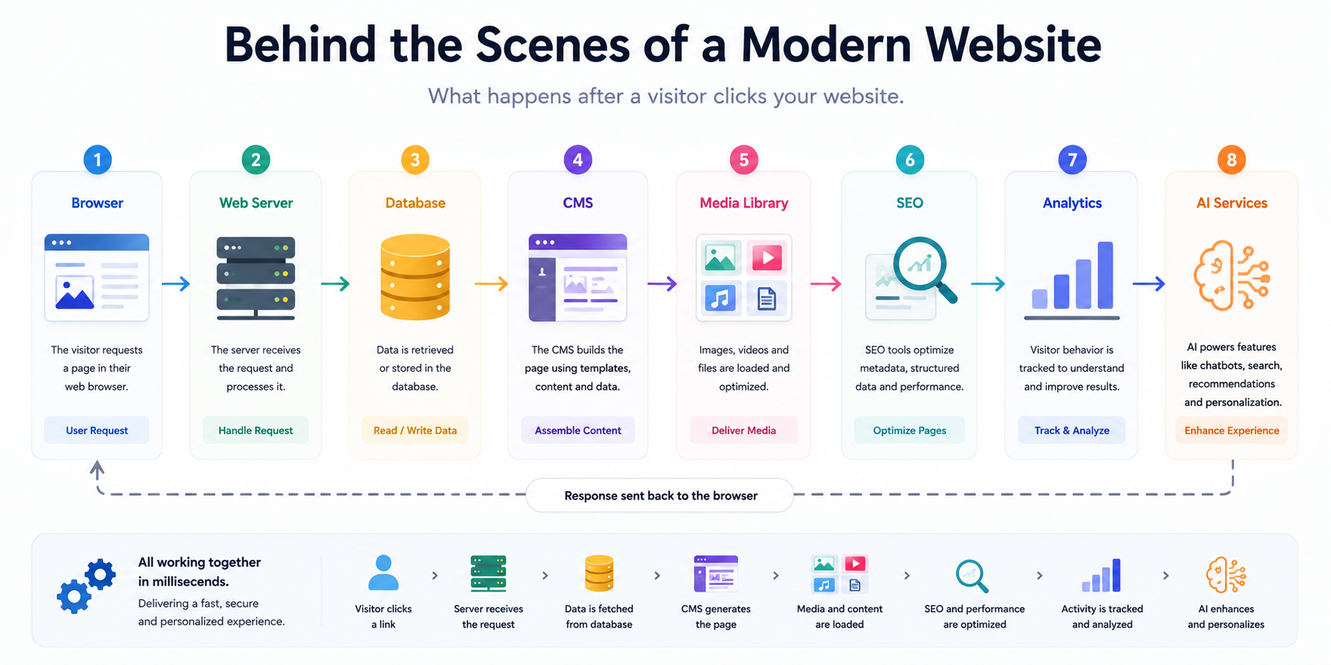
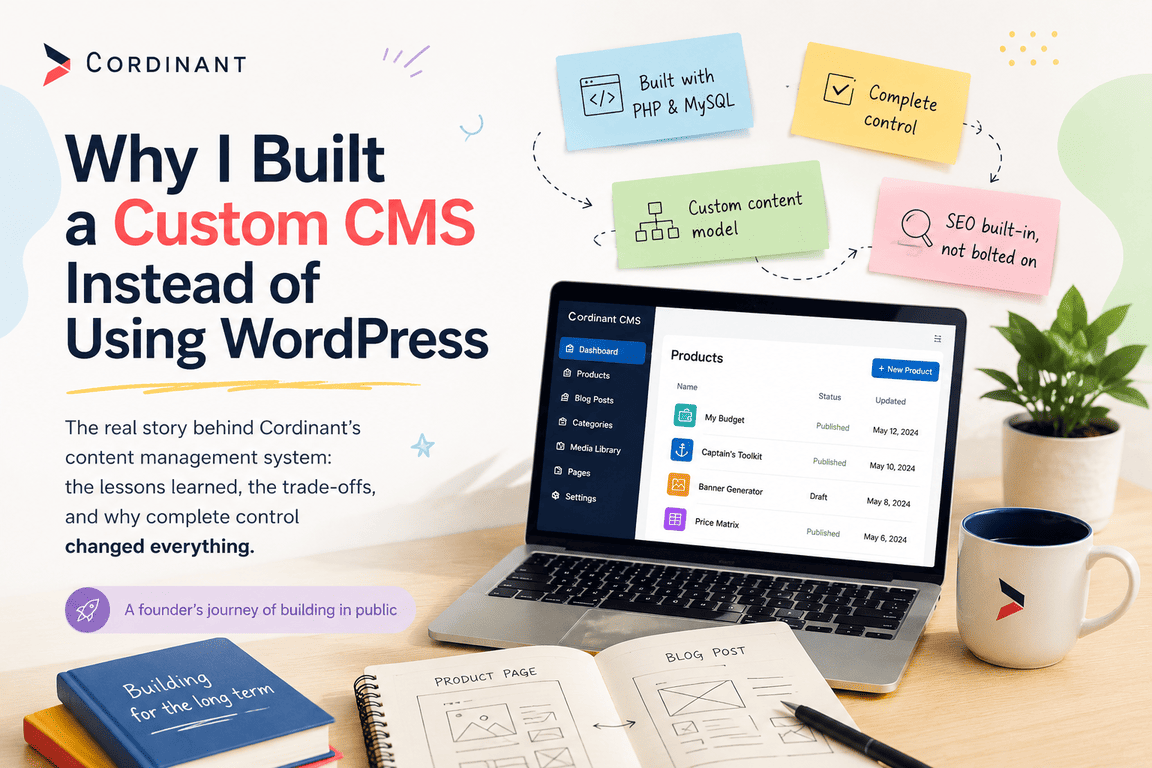
Building Cordinant made this particularly clear to me. What appears to be a fairly straightforward website is supported by an administration panel, custom content structures, product management, media handling, SEO fields, documentation and publishing workflows. None of those systems are especially visible from the front end, yet they influence almost every page.
This seems to be happening across many industries. Businesses increasingly invest not only in what customers see but also in the tools that allow teams to maintain, update and improve the website efficiently over time.
A Website Is Becoming Part of a Larger Digital Ecosystem
Perhaps the most noticeable change is that businesses rarely rely on a single digital channel anymore. Websites connect with newsletters, CRM systems, payment providers, customer portals, social platforms, analytics tools, AI services and countless other applications.
The website still plays an important role, but it is increasingly one component within a larger ecosystem rather than the entire system itself. Some businesses need only a few of these connections. Others build entire products around them.
That doesn't automatically make the traditional website outdated. It simply means the answer depends much more on the business than it once did. A local café and a software company can both have excellent websites while requiring completely different levels of functionality behind them.
In the final part, we'll explore where traditional websites still make perfect sense, where web applications offer clear advantages, and why there may never be a single answer to the question posed at the beginning of this article.
When a Traditional Website Is Still the Right Choice
After looking at AI, web applications and changing user expectations, it's easy to conclude that every business now needs something far more sophisticated than a traditional website. I don't think that's true.
Many businesses simply don't have problems that require complex software. A restaurant doesn't necessarily need a custom client portal. An architect may not benefit from building an interactive dashboard. A local accounting firm can attract new clients with a well-written website that clearly explains its services and makes it easy to get in touch.
Sometimes simplicity is an advantage rather than a limitation. Fewer moving parts usually mean lower costs, easier maintenance and fewer opportunities for something to break.
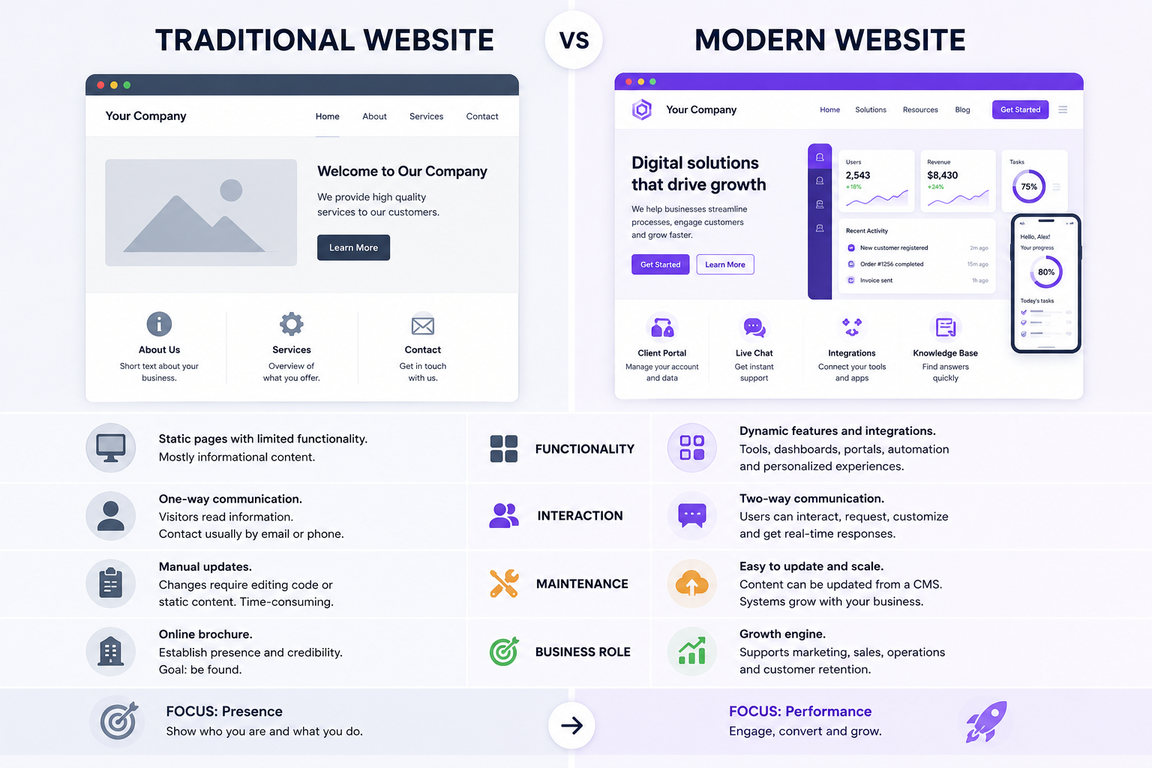
| A traditional website may be enough when... | Additional software becomes valuable when... |
|---|---|
| Your goal is to present information clearly. | Visitors need to complete tasks or manage data. |
| Content changes only occasionally. | Content is updated frequently by multiple people. |
| Most enquiries happen by phone or email. | Customers expect online accounts or self-service features. |
| Your business operates largely offline. | Your business depends on digital workflows. |
Complexity Comes With Its Own Costs
Software developers often enjoy building new features. Business owners often enjoy imagining them.
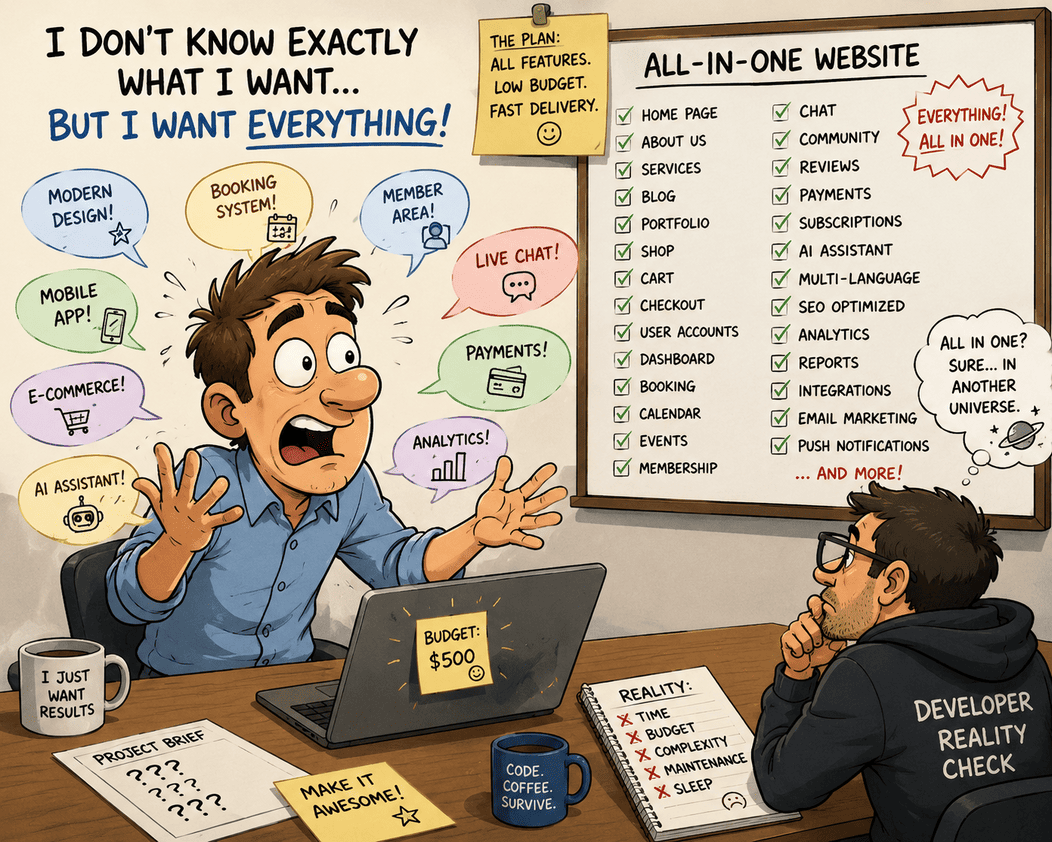
Every login system, customer dashboard, booking platform or AI assistant introduces another layer that has to be designed, tested, secured and maintained. Features that look impressive in a product roadmap can quietly become long-term maintenance responsibilities.
I've experienced smaller versions of this while building Cordinant. Adding one new capability rarely affects only a single page. It usually means updating the database, administration panel, media management, navigation, SEO fields and documentation. The visible feature might take a day to build, while everything surrounding it takes considerably longer.
That isn't a reason to avoid ambitious projects. It's simply a reminder that software almost always grows in more places than expected.
Every new feature solves one problem while quietly creating several new responsibilities.
Not Every Website Needs to Become a Platform
Some of today's most successful digital products are remarkably focused. They solve one problem well without trying to become an all-in-one platform.
The same principle can apply to websites. A company doesn't need to imitate every large technology business or adopt every emerging trend. Visitors usually care far more about finding accurate information, completing their task efficiently and trusting the business than they do about how many advanced features appear on the homepage.
There is also a tendency to compare small businesses with companies that employ hundreds of designers, developers and product managers. Those comparisons are rarely useful. The constraints are completely different, and so are the goals.
Choosing not to build a feature can be just as deliberate a decision as choosing to build one. Sometimes maintaining a simpler website allows more time to improve the content, products or service itself.
Perhaps the Better Question Is Different
While writing this article, I found myself returning to the original question several times. Is the traditional website still enough in 2026?
The answer seems to depend less on technology and more on purpose.
If the goal is to establish credibility, explain what a business does and provide a clear way for customers to make contact, a traditional website can still do its job remarkably well. Millions of businesses continue to rely on exactly that.
If the website is expected to deliver services, manage customers, automate processes, publish large amounts of content or become part of a wider digital product, then the conversation changes. At that point, the website often becomes only one visible layer of a much larger system.
Looking Beyond the Homepage
Building Cordinant has made me appreciate this distinction far more than I expected. When I began, I thought I was creating a website for publishing products and articles. As the project evolved, I realised I was also building a content management system, a product catalogue, a media library, publishing workflows and a growing collection of tools that exist almost entirely behind the scenes.
Visitors will probably never notice most of that work, and that's perfectly fine.
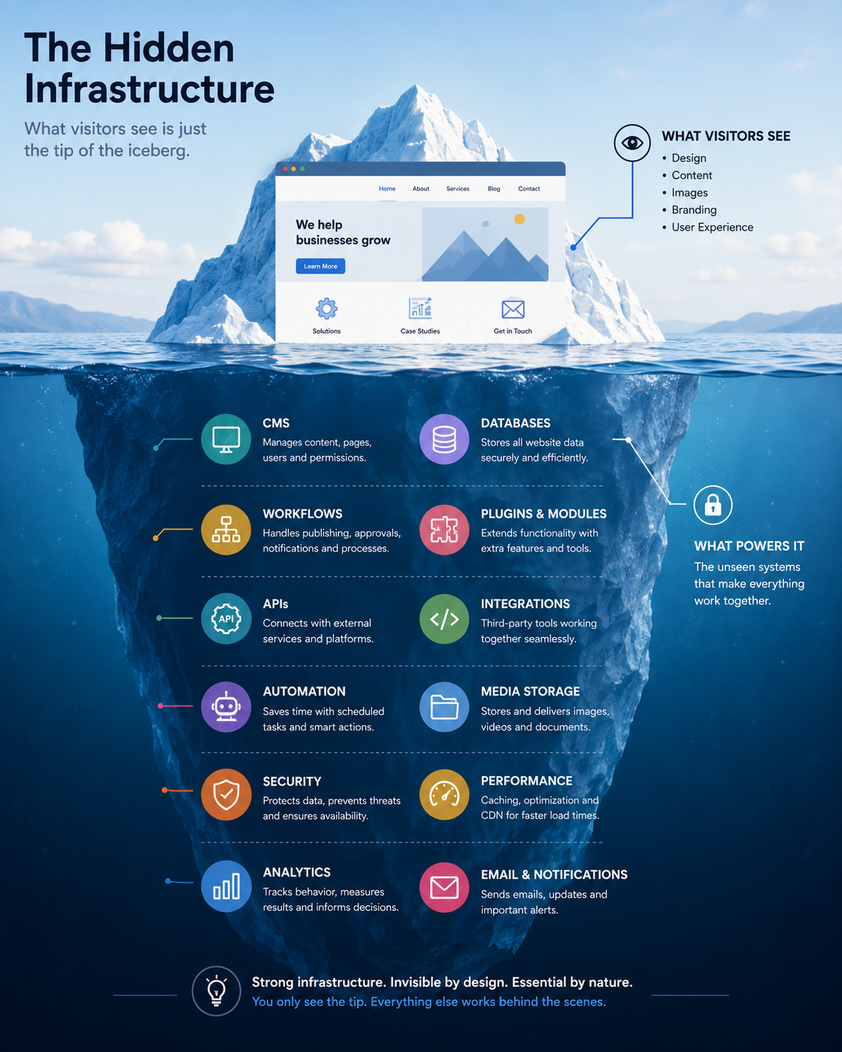
That may be the biggest change since the early days of the web. A website is no longer defined only by the pages people can see. Increasingly, it is shaped by the systems, content and processes that support those pages.
So, is the traditional website still enough in 2026? Sometimes, absolutely. Sometimes, not even close. The interesting part isn't choosing one answer over the other. It's understanding that the question itself has become more nuanced than it used to be, and that's probably a sign of how much the web has matured rather than evidence that the website is disappearing.