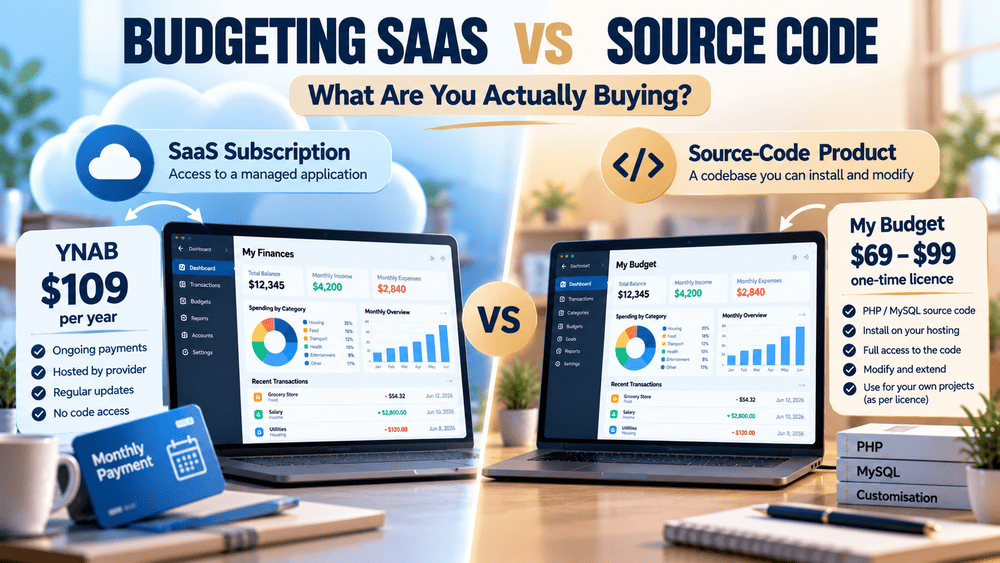
I was looking at the prices of personal finance applications while thinking about where my own product, My Budget, fits into the market. The first comparison seemed straightforward enough. YNAB costs $109 a year, Lunch Money offers an annual subscription starting at $100, and Goodbudget Premium costs $80. My Budget is a PHP/MySQL source-code product, with a Standard licence priced in a similar range.
At first, that looks like an interesting pricing opportunity. A year of access to one application can cost roughly as much as buying the source code of another. But the longer I looked at these products, the less useful the price comparison became.
The problem wasn't that the applications had nothing in common. They did. Most dealt with transactions, spending categories, budgets, savings goals or financial reports. Some offered considerably more sophisticated features than My Budget. Yet the biggest difference wasn't necessarily in the features at all.
It was in what the customer was actually buying.
What Does a Personal Finance App Cost?
Personal finance software has become a fairly established subscription market. Some applications offer free versions, others provide trials, and many reserve their more advanced features for paying customers.
The prices also vary more than you might expect. A relatively focused budgeting tool can cost around $80–100 annually, while applications with extensive forecasting, bank connections and other financial management features can cost considerably more.
Here is a selection of established personal finance products and their advertised subscription prices, based on pricing information researched in September–October 2026.
| Product | Monthly price | Annual subscription | Model |
|---|---|---|---|
| YNAB | $14.99 | $109 | SaaS |
| Lunch Money | $10 | From $100 | SaaS |
| Goodbudget Premium | $10 | $80 | SaaS |
| PocketSmith Foundation | $14.95 | $119.95 | SaaS |
| PocketSmith Flourish | $24.95 | $199.95 | SaaS |
| PocketSmith Fortune | $39.95 | $319.95 | SaaS |
| Quicken Simplifi | $3.99 promotional | $47.88 promotional | SaaS |
Prices are in USD and may change. Quicken Simplifi's promotional rate is billed annually, with a regular advertised rate of $6.99 per month. Lunch Money offers annual pricing starting at $100. These figures are intended to illustrate pricing models, not to provide a complete comparison of subscription terms or features.
There are several interesting things about this table.
First, paying around $100 a year for personal finance software is hardly unusual. Second, more expensive subscriptions do not necessarily mean the provider is charging excessively. Products such as PocketSmith offer financial forecasting, bank feeds and other capabilities that require infrastructure, ongoing development and maintenance.
And third, the table only describes one part of the market. It shows what people pay to use financial applications, not what developers pay to acquire software they can modify.
That distinction changes the comparison considerably.
Two Similar Dashboards Can Hide Two Very Different Products
Imagine opening two personal finance applications in separate browser tabs.
Both have a dashboard with income and expense summaries. There are transaction lists, spending categories, charts and savings goals. Perhaps both offer CSV exports and reports. At a glance, they appear to serve much the same purpose.
If you were comparing screenshots, you might reasonably put them in the same category.
But now consider what happens when somebody wants to change how the application works.
With a conventional SaaS product, the customer can usually customise whatever the provider has made configurable. They might create categories, connect accounts, adjust budgets or change dashboard settings. However, they generally cannot open the application's server-side code, modify its database structure or develop a new feature directly inside the provider's platform.
That isn't a flaw. It's part of the service model.
The provider develops and operates the application, while the customer uses the features it makes available.
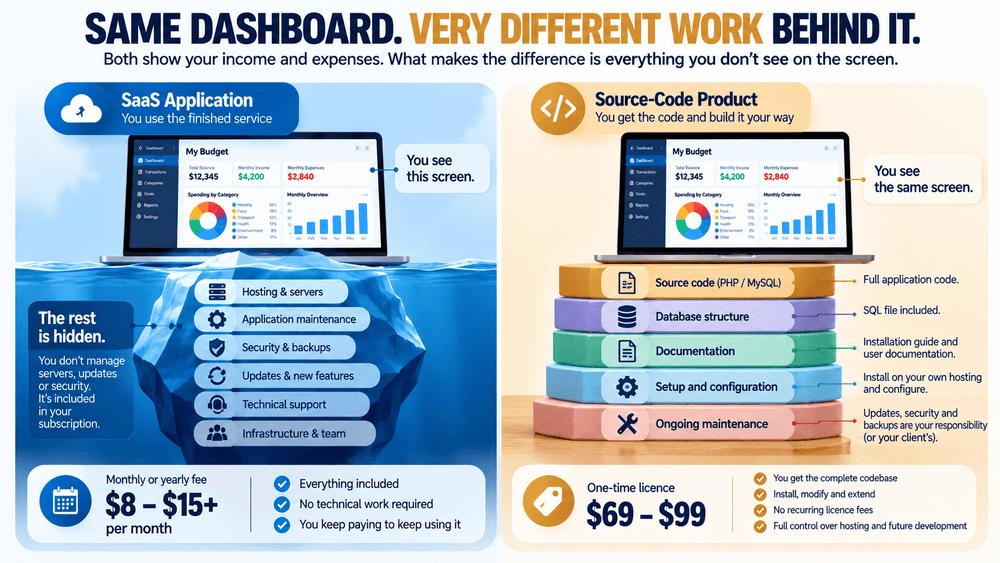
A source-code product has a different purpose. The buyer receives software files and, depending on the package and licence, the ability to install, inspect, modify and extend the application.
The difference becomes especially visible when a project needs something the original application wasn't designed to do.
Suppose a developer wants to turn a personal budgeting interface into a specialised expense tracker for freelancers. They might need client-related categories, project-based transactions or different reports. In a subscription application, those changes depend on the features and customisation options the provider offers.
With an editable codebase, the developer can build them.
Of course, being able to modify software and actually having the time and skills to do so are two different things.
What $109 a Year Buys From YNAB
YNAB is a useful reference point because it is an established budgeting product with a recognisable approach to managing money.
Its subscription currently costs $14.99 per month or $109 annually, with a 34-day free trial. Customers receive access to an application built around YNAB's budgeting method, along with its supported features, web and mobile experiences, account connections where available, and ongoing product development.
Someone subscribing to YNAB is unlikely to be thinking about database tables or application architecture. They want to manage their finances, understand their spending and make better decisions about their money.
The technical work is largely somebody else's responsibility.
The same broad principle applies to Lunch Money, Goodbudget, PocketSmith and Quicken Simplifi, although their features, approaches and intended audiences differ.
Lunch Money, for example, offers a focused personal finance experience with transaction management, budgeting and reporting. PocketSmith places considerable emphasis on financial forecasting and connections to financial institutions. Goodbudget takes an envelope-budgeting approach, while Simplifi brings together spending plans, savings goals and broader financial tracking.
These are not identical products, and there are good reasons why one customer might prefer one over another.
But commercially, they share a central characteristic: the customer pays for access to software that somebody else operates.
For a person who simply wants to manage household finances, this arrangement can be very convenient. They don't need to install PHP, configure MySQL, arrange hosting or think about application security.
They can concentrate on using the product.
That convenience is part of what the subscription pays for.
Buying My Budget Means Buying Something Else
My Budget started from a different product idea. I described its origins in I Wanted to Know Where My Money Was Going, So I Built My Budget.
Rather than offering another hosted personal finance subscription, I built My Budget as a self-hosted PHP/MySQL source-code product. The package provides an existing application foundation, including user authentication, transaction management, categories, financial goals, dashboard analytics, reports and other supporting functionality.
A developer can install it on compatible hosting, examine how the application works and adapt the code for a different project, subject to the purchased licence.
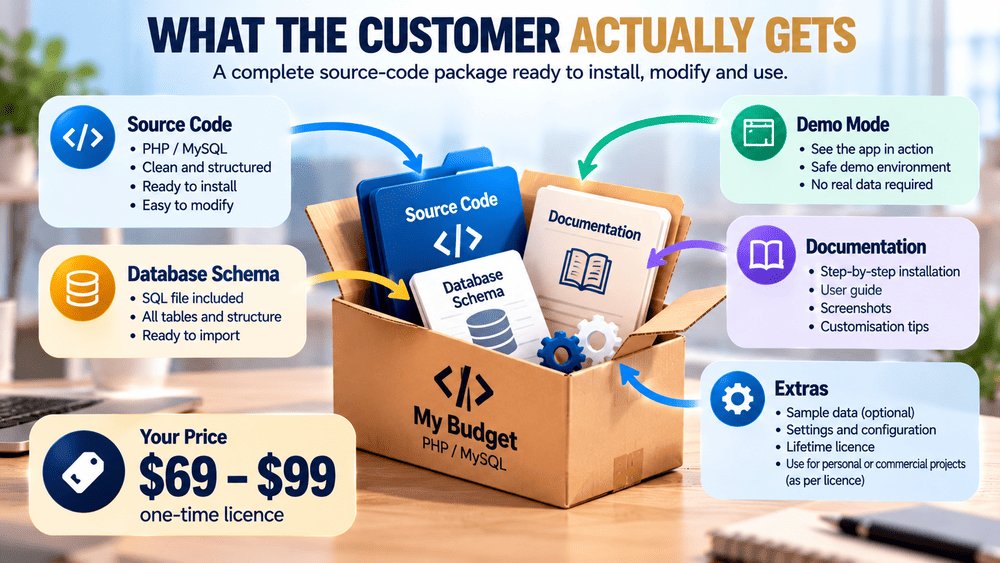
The intended buyer isn't necessarily somebody who needs to track their own grocery spending. It could be a PHP developer, a small agency, a founder building a financial tool or someone experimenting with a specialised application.
That buyer might be interested in the budgeting interface, but they are also interested in what sits underneath it.
How are transactions stored? How are categories connected to users? How is authentication handled? Can the interface be redesigned? Could the reports be changed? What would it take to introduce another financial workflow?
Those questions are largely irrelevant to somebody looking for a ready-to-use subscription service. For somebody building software, they can be central to the purchasing decision.
The existing code provides a starting point. It doesn't remove the need to understand the application or develop whatever new functionality the project requires.
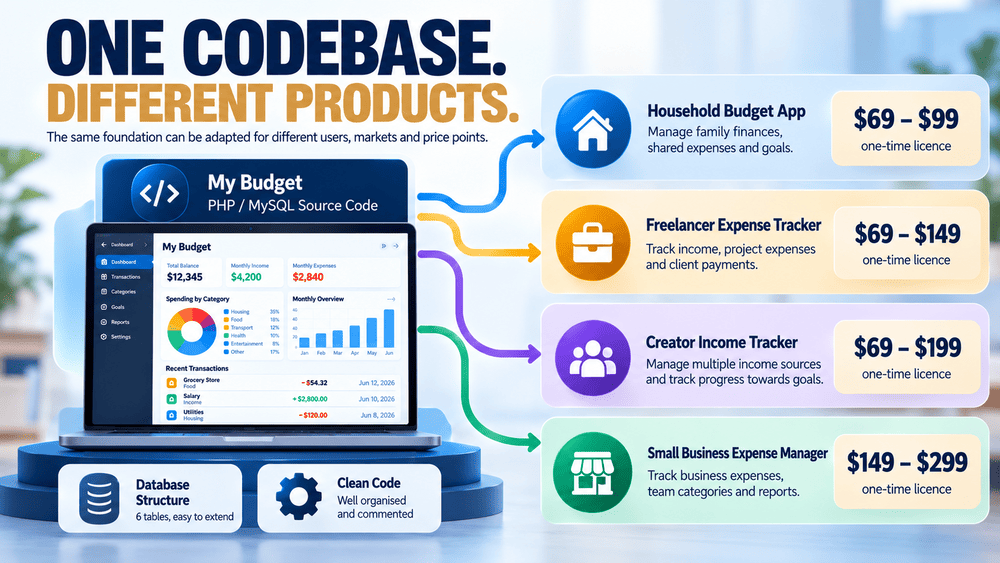
For example, My Budget could potentially become the foundation for several different kinds of financial tools:
- A freelancer expense tracker, with project-related transactions, client categories and tailored reports.
- A household budgeting application, with a redesigned interface and features adapted to shared financial planning.
- A creator income tracker, with income sources, recurring expenses and reports organised around creative work.
- A small business expense manager, with additional business-specific categories, permissions and workflows.
- A travel budget tracker, with trip-based budgets, expense categories and potentially currency-related features.
These are possible development directions, not finished versions included with My Budget. Some would require relatively modest interface changes, while others would need substantial database and application development.
The point is that the buyer can work with the code instead of waiting for a software provider to introduce a particular feature.
That flexibility is the product's main attraction, but it also comes with responsibilities that a typical SaaS customer never has to consider.
The Tempting Mathematics of a One-Time Licence
There is an obvious way to market a source-code product against subscriptions: compare the upfront purchase price with several years of SaaS payments.
The numbers are easy to calculate.
| Period | YNAB | Lunch Money |
|---|---|---|
| 1 year | $109 | $100 |
| 2 years | $218 | $200 |
| 3 years | $327 | $300 |
| 5 years | $545 | $500 |
Illustrative totals assume unchanged annual subscription prices and continuous subscriptions. Lunch Money calculations use its $100 annual starting price.
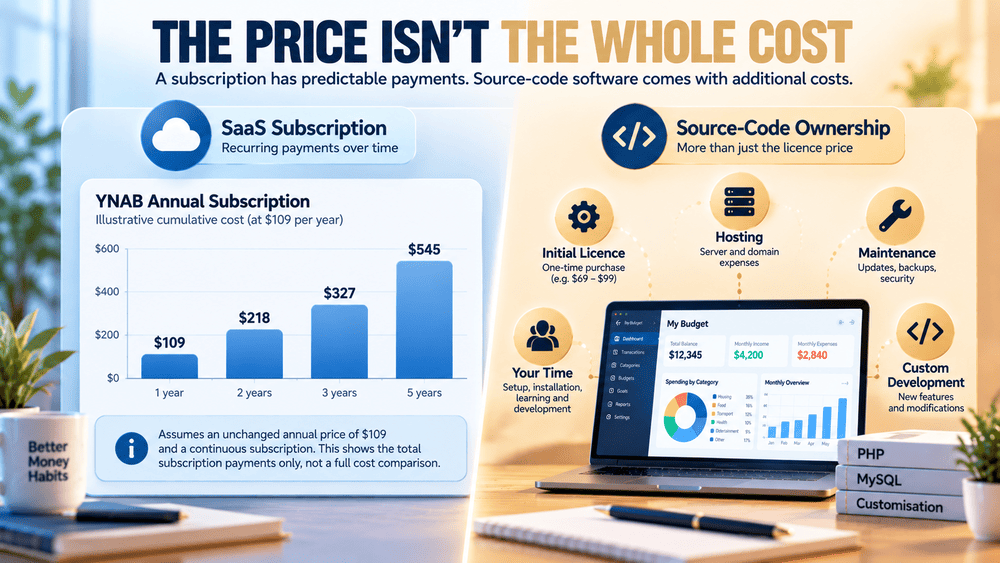
A source-code licence priced at $69 or $99 looks inexpensive beside those cumulative figures.
It would be easy to turn that into a marketing message: buy the code once instead of paying every year.
But I don't think that comparison tells the whole story.
A subscription includes much more than the right to open an application. The provider operates the infrastructure, maintains the software, develops features and deals with many of the technical problems that customers never see.
With self-hosted source code, those responsibilities don't disappear. They move to the buyer.
Even a relatively simple PHP application needs somewhere to run. It needs a compatible server environment, database configuration, backups, security updates and occasional maintenance. If the buyer wants additional features, those need to be designed, implemented and tested.
Hosting may be inexpensive, particularly when a developer already has suitable infrastructure. But development time can cost far more than the original licence.
There is also an important difference between buying a source-code licence and owning unrestricted rights to a piece of software. A licence determines what the buyer can modify, redistribute, deploy commercially or incorporate into other products. Paying once doesn't automatically grant every possible right.
So while the subscription arithmetic is interesting, it isn't a complete cost comparison.
The more useful question is whether the buyer values the convenience of a managed application or the ability to work directly with the software.
Access and Control Are Not the Same Thing
The two models can be reduced to a fairly simple comparison, although real software businesses often use combinations of both.
| Consideration | Budgeting SaaS | Self-hosted source code |
|---|---|---|
| What is purchased? | Access to an application | A licence to use the codebase |
| Who operates the software? | SaaS provider | Buyer or their hosting provider |
| Source-code access | Generally unavailable | Included |
| Customisation | Provider-supported options | Code-level changes possible |
| Infrastructure | Provider-managed | Buyer-managed |
| Maintenance | Largely provider-managed | Buyer's responsibility |
| Initial technical knowledge | Usually minimal | Development or deployment skills needed |
| Payment model | Usually recurring | Often a one-time licence |
| Best suited to | People who want to use software | People who want to build with software |
The table makes self-hosting look attractive in some areas and less attractive in others, which is exactly the point.
Control is useful when you need it. When you don't, it can become unnecessary work.
A person who wants to track household expenses probably doesn't want the additional responsibility of maintaining a PHP application. Even if the source-code licence costs less than a year of SaaS, the overall experience could be far less convenient.
A developer building a specialised financial product might reach the opposite conclusion. For that buyer, a subscription to an existing budgeting service may not provide the technical flexibility the project requires.
Neither choice is automatically more sensible. It depends on what somebody is trying to accomplish.
The Buyer Changes the Meaning of the Price
Consider two people looking at a budgeting application.
The first is a self-employed designer who wants to keep personal spending organised. They need to categorise expenses, monitor their budget and see where their money goes each month. They have no interest in hosting software or changing its code.
For this person, a subscription to a ready-made application may be a perfectly reasonable purchase. The price reflects access to a functioning service, not just a collection of features.
The second person is a freelance developer whose client wants an internal expense-management tool. The client has specific requirements that a general-purpose budgeting application doesn't quite cover. Perhaps transactions need to be associated with projects, reports must follow a different structure or the interface needs to fit an existing business workflow.
The developer could start building everything from scratch. They could also examine whether an existing codebase would save some of the initial work.
Suddenly, a $69–99 source-code licence has a completely different meaning.
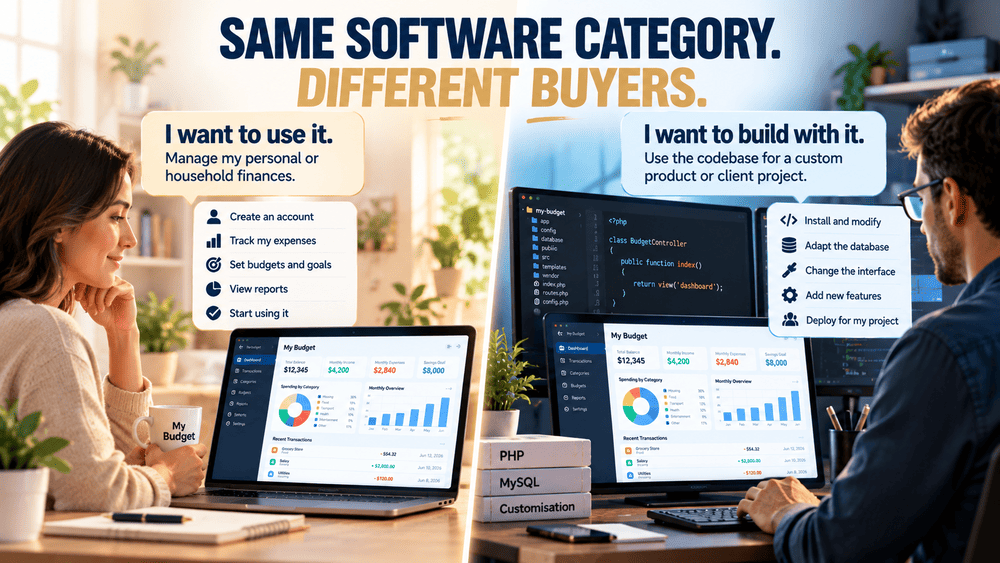
It isn't being compared with the cost of managing personal finances for a year. It's being compared with the time and effort required to build an application foundation.
Authentication, database relationships, transaction forms, category management and reporting functionality all take time to develop and test. Having an existing implementation may be useful, provided its architecture, code quality and licence are suitable for the intended project.
That doesn't mean buying code is always faster. Sometimes understanding and modifying somebody else's application takes longer than building a small system yourself. An existing codebase can also introduce design decisions and dependencies that don't suit the new project.
But at least the comparison now makes sense.
The developer is evaluating a development asset, not shopping for a personal budgeting subscription.
What About Other Source-Code Products?
There is another side to this market that is closer to My Budget's actual business model.
Marketplaces such as CodeCanyon and Gumroad offer many kinds of application source code, scripts, templates and software packages. Some are small starting points; others are extensive applications with installation tools, documentation and commercial licensing options.
For somebody selling source code, these products are often more relevant pricing references than established SaaS services.
A developer evaluating two PHP applications can compare things that matter directly to the purchase: framework or architecture, database structure, included functionality, installation requirements, documentation, licence terms and the amount of additional work likely to be necessary.
These comparisons are useful when deciding what to include in a product and how to price it.
I am less interested, however, in turning that research into public articles declaring that one independent creator's product is better than another.
Software packages can be built for different purposes, and their value isn't always obvious from a feature checklist. A smaller application with clear code and straightforward installation may suit one project better than a much larger package. Another developer might prefer the larger system because it already contains the features they need.
There is also something rather unproductive about treating every other independent software creator as an opponent. Understanding the market doesn't require publicly criticising the people working in it.
For Cordinant, I find the broader distinction between subscription software and source-code products more interesting than a ranking of individual marketplace listings.
Why I Wouldn't Describe My Budget as a Cheaper YNAB
It might sound like a convenient marketing shortcut.
YNAB costs $109 a year. My Budget offers a one-time source-code licence in a similar price range. Why not position My Budget as the cheaper alternative?
Because that would create expectations the product isn't intended to meet.
YNAB has an established budgeting methodology, bank connections, mobile applications and a mature service ecosystem. PocketSmith offers sophisticated financial forecasting. Lunch Money has its own approach to personal finance management and integrations.
My Budget doesn't need to pretend to offer the same experience.
Someone searching for a ready-to-use YNAB alternative may expect to sign up, connect financial accounts and start budgeting immediately. They may be disappointed to discover that My Budget is a downloadable PHP/MySQL application requiring installation and technical management.
That would be a positioning problem rather than a pricing problem.
A more accurate description is that My Budget provides an editable application foundation for people who want to develop or adapt personal-finance software.
The difference may sound subtle, but it affects everything from the product page to the documentation, demo and licence information.
It also affects which search queries are genuinely relevant.
Someone searching for "best budgeting app for couples" is probably looking for a finished service. Someone searching for "PHP budgeting app source code" may have a much stronger reason to consider a product like My Budget.
Attracting more visitors isn't particularly useful if most of them are looking for something the product doesn't sell.
There Is Also a Middle Ground
The distinction between SaaS and source code is useful, but the real software market isn't always divided into two neat categories.
A company might buy source code and then use it to build a subscription application of its own. An agency might purchase a codebase, customise it for a client and deploy it on managed hosting. A developer might combine a self-hosted application with external APIs or third-party services.
There are also open-source applications that people can host themselves, as well as commercial products that offer both hosted subscriptions and self-hosted deployment options.
In other words, the way software is developed, licensed, hosted and sold can involve several different decisions.
Buying source code doesn't automatically mean the finished application must remain a self-hosted product. Equally, building a SaaS business doesn't necessarily require writing every component from scratch.
For My Budget, this opens up possibilities beyond the original personal-finance interface. A developer could use the codebase for a specialised internal application, a client project or potentially a broader commercial product, depending on the licence and the development work involved.
That is a different kind of value from simply providing a budgeting service to an end user.
So What Is a Budgeting Application Actually Worth?
After looking at the subscription prices, I came away with a slightly different view of the question.
At first, I was interested in whether a source-code product priced around $69–99 looked reasonable beside personal-finance applications costing $80, $100 or $120 a year.
The figures were useful, but they didn't really answer the question.
A SaaS customer is evaluating how much a functioning financial service is worth to them. A developer buying source code is evaluating whether an existing application can provide a useful foundation for something they want to build.
Those are different purchasing decisions, even when the applications have similar interfaces.
And there is no guarantee that the source-code buyer will spend less in the long run. They may spend considerably more on hosting, modifications, testing and maintenance. The difference is that they can direct that work towards their own requirements.
For someone who wants to manage a household budget, a subscription may be the simpler and more economical choice. For someone who wants to build a financial application, an editable codebase may be far more useful than access to an established service.
I still think subscription pricing is worth studying when developing and positioning My Budget. It helps explain the wider personal-finance software market and the value people place on working financial tools.
But it also shows why price comparisons can be misleading when the products themselves are sold in fundamentally different ways.
Two applications can display similar transactions, categories and charts. They can even cost roughly the same amount at the point of purchase. Yet one customer is paying to use software, while another is paying for the opportunity to work with it.
Sometimes the most important difference between two pieces of software isn't visible on the dashboard at all. It's what you are allowed — and expected — to do with the software after you've paid for it.