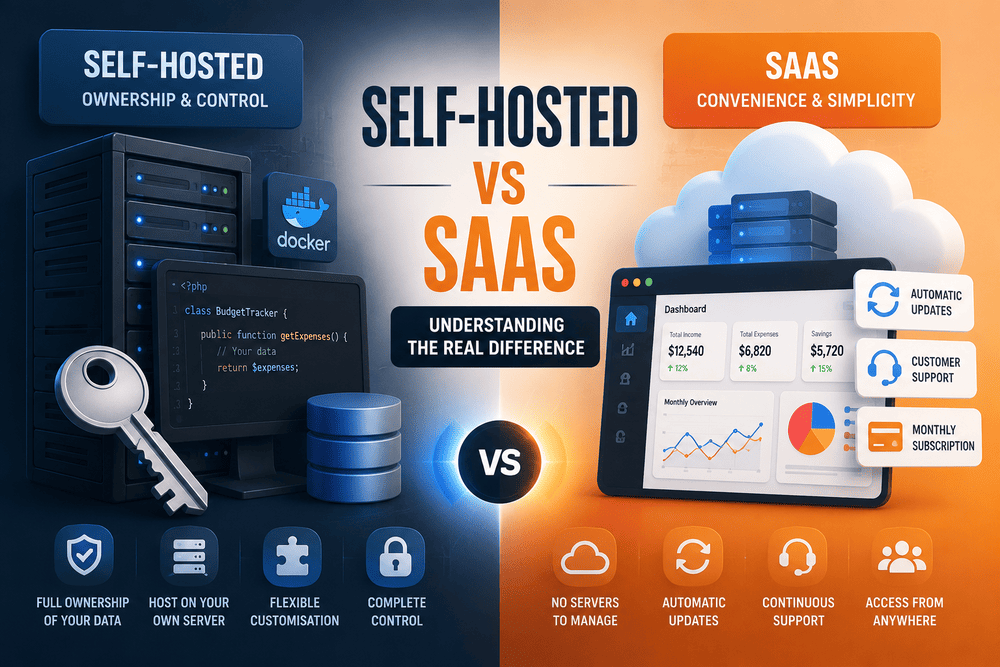
Two people can buy exactly the same software and walk away with two completely different products.
One person might install it on a server, create an account and start using it. Another might open the source files before they even look properly at the interface. They change the branding, remove three features, add five others and eventually turn the application into something its original developer would barely recognise.
They both bought the same ZIP file.
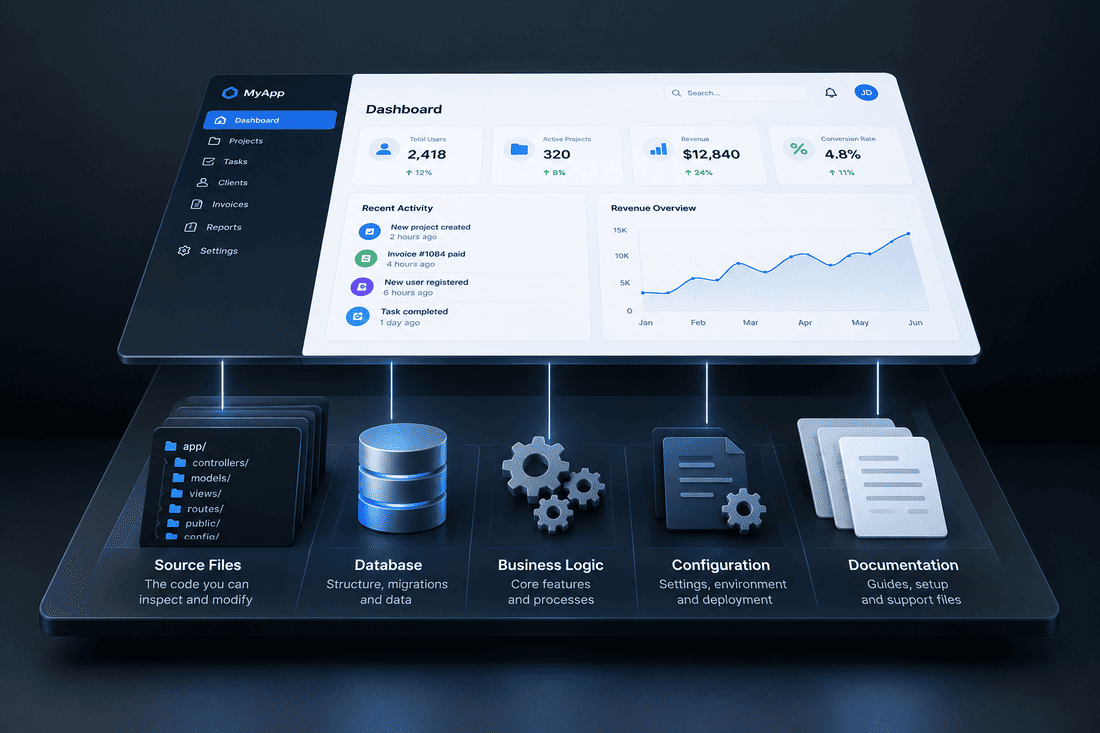
This is one of the things I find interesting about source-code products. With most software, what you see on the screen is essentially what you are buying. With source code, the visible application is only the beginning.
The code underneath it is part of the product too.
And that changes both what is being sold and who might want to buy it.
The Strange Product Inside the ZIP File
Most of us are familiar with paying for software without owning the software itself.
You create an account, choose a plan and use an application through a browser or mobile app. The company behind it operates the servers, maintains the application and decides what happens to the product next.
That's the familiar SaaS model.
Buying source code is different.
A source-code product is usually an existing piece of software supplied with the files that make it work. Depending on the product and its licence, the buyer can install it on their own infrastructure, inspect how it works, modify it and adapt it for a particular purpose.
It might be a finance application, booking system, CRM, dashboard, CMS, mobile app, developer tool or something much more specialised.
The important part is that you aren't merely receiving permission to log in to somebody else's running application.
You receive the application itself.
That sounds like a small distinction until you start thinking about what someone can do with it.
A Source-Code Product Is Still a Product
The word code can make this category sound more primitive than it really is.
There is an enormous difference between a folder containing some PHP files and a software product that happens to include its source code.
A usable source-code product might include an installer, database structure, authentication, configuration, user interface, documentation, demo data, error handling and the various small pieces required to make the application work as a whole.
This distinction became much clearer to me while building my own source-code products.
Getting an application to work for myself is one thing. Preparing it so another person can download it, understand it, install it and continue working with it is another.
Suddenly details that seemed secondary become part of the product.
- How is the database created?
- Where does the buyer enter the database credentials?
- What happens during installation?
- What should the demo contain?
- Which settings should be configurable?
- What needs explaining in the documentation?
The source files are certainly part of what is being sold.
But simply having source files doesn't make something a finished source-code product.
It Isn't the Same Thing as Open Source
There is another distinction worth making because the terminology can become confusing.
Having access to source code does not automatically make software open source.
Open-source software is distributed under licences that grant particular rights to use, inspect, modify and redistribute the software. A commercial source-code product can also give a buyer access to its code while imposing very different conditions.
For example, a licence might allow someone to modify an application for their own project but not package the original source code and start selling copies of it.
Another licence might allow client work or commercial use under particular conditions.
The important part isn't that one approach is more open or more restrictive. They are simply different models.
When someone buys a commercial source-code product, the licence is part of what they are buying too. Having the files does not automatically mean having unlimited rights to do anything with them.
Somewhere Between SaaS and Starting From Nothing
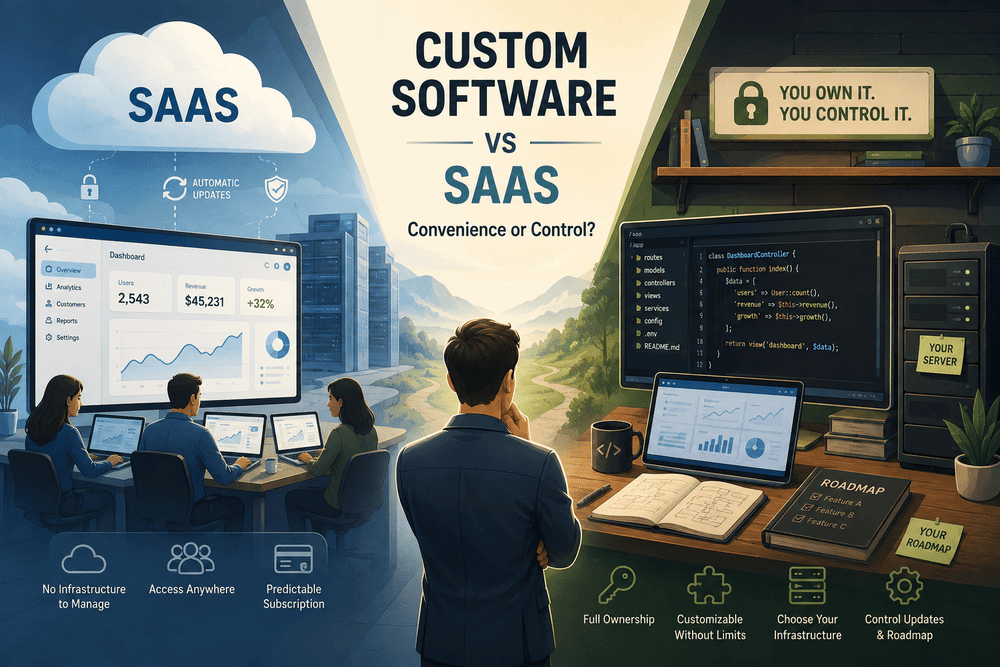
I tend to think of source-code products as occupying an interesting space between SaaS and custom development.
With SaaS, much of the responsibility remains with the vendor. You normally don't worry about deploying the application, maintaining its infrastructure or fixing its code. In exchange for that convenience, you accept that most of the application remains outside your control.
At the opposite end, you can build software from scratch.
Then almost every technical decision can be yours. The database, architecture, interface, workflows and integrations can all be designed around the specific project.
The obvious downside is that somebody has to build all of it.
A source-code product sits somewhere in the middle.
| Approach | What You Start With | Where Responsibility Sits |
|---|---|---|
| SaaS | Access to a running service | Mostly with the vendor |
| Source-code product | An existing application and its code | More responsibility moves to the buyer |
| Custom development | A project built around specific requirements | With the development team or owner |
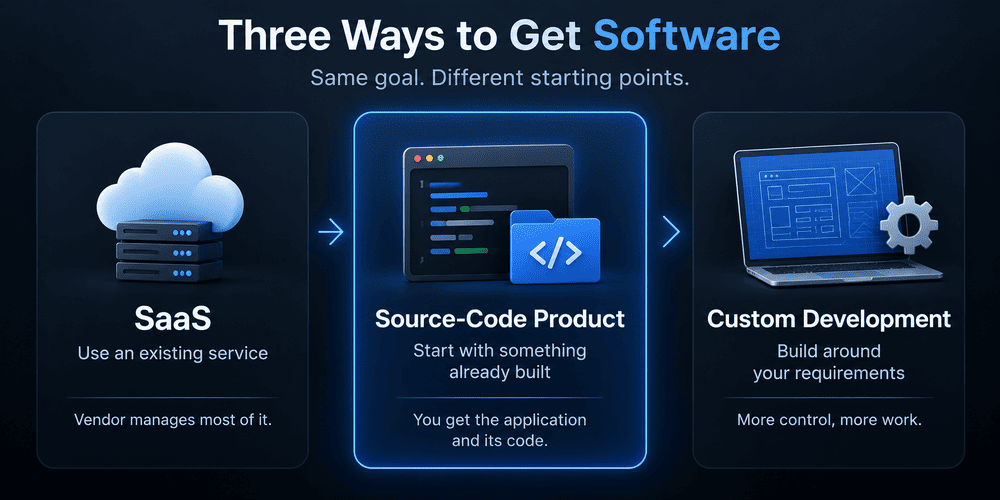
You don't start from an empty directory, but you don't receive a service that someone else completely controls either.
You start with something that already exists.
That difference is probably more important than it first appears.
The Developer Who Could Build It Anyway
It is easy to imagine that people buy source code because they don't know how to program.
In many cases, the opposite makes more sense.
A developer may buy source code precisely because they know how much work is hiding behind an apparently simple application.
Authentication isn't particularly exciting to build for the twentieth time. Neither are settings pages, CRUD interfaces, exports, validation, database migrations or another password-reset flow.
None of these things may be especially difficult individually.
Together, they consume time.
If an existing application already provides a large part of the required foundation, a developer can potentially start further along.
That doesn't mean pressing a button and receiving a finished project. Someone still has to understand the code, decide whether its architecture is suitable and make whatever changes the new project requires.
But the starting point is different.
A developer buying source code isn't necessarily paying for knowledge they don't have. Sometimes they're paying not to repeat work they already know how to do.
The Freelancer Who Doesn't Want Every Client Project to Start at Zero
Freelance development creates another interesting use case.
Imagine a client needs an internal application containing users, categories, reports, exports and a dashboard. The details may be unique to that business, but a substantial part of the technical foundation is not.
The freelancer has several options.
They can build everything from scratch. They can assemble the project from frameworks, libraries and components. Or, where the licence and technical fit allow it, they can start from an existing application and customise it.
The third option isn't automatically faster.
Poorly structured code can turn a shortcut into a long detour. An application built around very different assumptions may require so much modification that starting again would have been easier.
This is where the quality of a source-code product becomes difficult to judge from screenshots.
A beautiful dashboard tells you very little about what happens after you open the project in an editor.
For a technical buyer, readability, architecture and documentation may eventually matter more than the interface that originally attracted them.
An Agency May See Raw Material
An agency can look at the same product differently again.
The original logo may not matter much. The exact colours might be irrelevant. Even parts of the workflow may eventually disappear.
What matters is whether the underlying application provides a useful foundation for something the agency needs to deliver.
A source-code product can therefore behave less like a finished product and more like prepared raw material.
There is already a database. There are already screens. The application already has business logic and relationships between its parts.
The agency's work starts from there rather than from nothing.
Licensing becomes particularly important in this situation. Not every source-code licence allows the same kind of client work, redistribution, white-labelling or commercial use.
That isn't a minor detail hidden at the bottom of a download page.
For some buyers, it determines whether the product is useful at all.
The Founder Who Is Really Buying Time
A founder presents another version of the same idea.
Suppose you have an idea for a product, but 60 or 70 percent of what it needs isn't what makes the idea interesting.
It still needs accounts.
It still needs a database.
It still needs settings, forms, dashboards, permissions, reports or whatever other ordinary machinery sits underneath the distinctive part of the product.
Building all of that may be necessary, but it isn't necessarily where the value of the idea lies.
Starting with an existing source-code application can change the first question from:
"How do I build this?"
to:
"How much of this is already built?"
Those are very different starting points.
There is a catch, though.
Buying existing code also means buying existing decisions.
Someone has already chosen the database structure. Someone has decided how different parts of the application communicate. Someone has chosen naming conventions, dependencies and patterns.
If those decisions align reasonably well with the new project, they can save substantial work.
If they don't, the supposed head start can eventually become something you spend your time fighting.
The Business That Simply Wants More Control
Not every source-code buyer needs to be a developer.
A small business might want an application running on infrastructure it controls. It might need modifications that aren't possible in a hosted product. It might want to integrate the application with an existing internal system.
Or perhaps it simply doesn't want another permanent SaaS subscription.
Buying software that can be self-hostedcan be attractive in those situations.
But self-hosting soft moves responsibility as well as control.
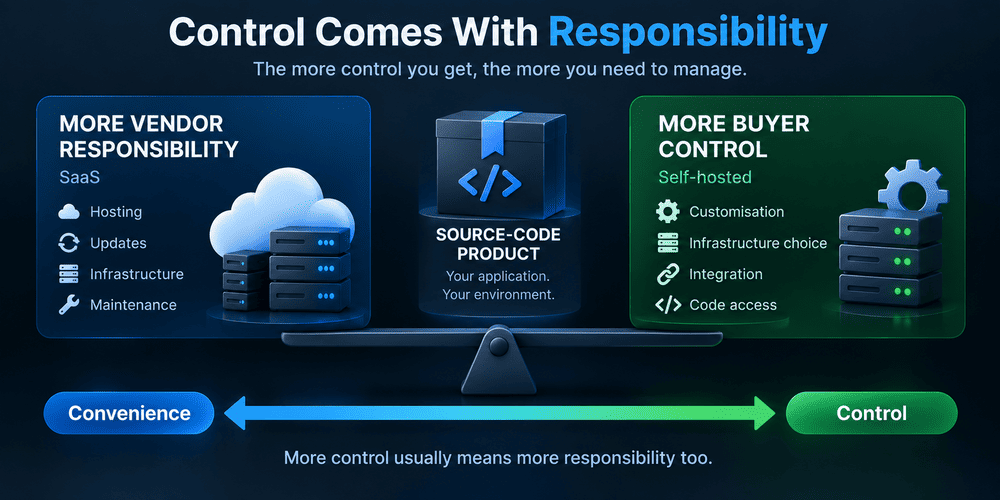
Someone now has to operate the server. Someone has to handle backups, updates and security. If something breaks, there may not be a SaaS provider quietly fixing the infrastructure in the background.
That trade-off is sometimes missing from conversations about software ownership.
More control sounds attractive. More responsibility tends to arrive in the same package.
So What Are You Actually Paying For?
This is the question I keep returning to.
The obvious answer is code.
Technically, that's correct. But it doesn't describe the whole product very well.
Consider even a relatively ordinary application.
Someone decided how the database tables relate to one another. They decided what happens when a user submits a form. They decided how authentication works, where configuration lives, how errors appear, how reports are calculated and how the interface moves from one screen to another.
There may be hundreds or thousands of small decisions inside a working application.
Some are visible.
Most aren't.
When you buy a source-code product, you are partly buying those previous decisions.
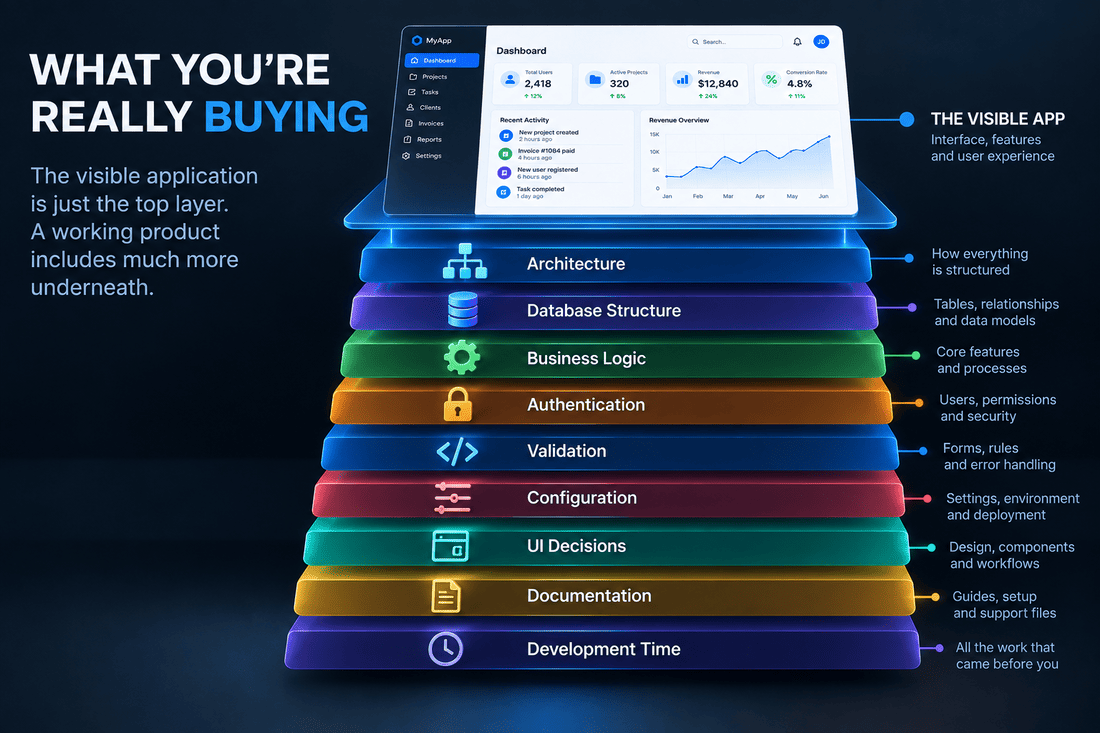
You are buying a point in the development process where many questions have already been answered.
You may later disagree with those answers.
You can change them.
But you don't begin with a blank editor and every possible decision still waiting for you.
That may be the real difference.
You're Also Buying the Boring Parts
There is a tendency to judge software by its interesting features.
A finance application has charts and reports. A booking application has calendars. A project-management tool has boards and tasks.
But finished software contains a lot of less impressive work.
- Login forms
- Validation
- Empty states
- Settings
- Database relationships
- Error messages
- Installation
- Navigation
- Deleting things without accidentally deleting the wrong things
A buyer might never say, "I'm purchasing this because somebody already spent time deciding how this settings page should behave."
Yet those ordinary details are part of the value.
They are also why comparing the price of a source-code product with the price of a few generated files can be misleading.
The quantity of code isn't particularly interesting. The question is how much useful, coherent work has already been done.
Then AI Arrived
There is an obvious complication in talking about source-code products now.
AI can generate code.
Quite a lot of it.
It can create database schemas, authentication examples, dashboards, forms, APIs and complete application components. That naturally raises the question of why someone would pay for existing source code when they can describe what they want and start generating it.
I use AI in my own development, so I don't find the argument that "AI code isn't real development" particularly convincing.
AI genuinely changes how quickly certain parts of an application can be created.
But I have also found that generating a component and having a coherent product are different things.
Generated code still has to fit the rest of the application. Decisions made in one part need to remain compatible with decisions made elsewhere. Interfaces change. Requirements change. Something that looked correct initially turns out to behave strangely three steps later.
AI can make development faster while simultaneously making it easier to generate more things that need to be checked.
Interestingly, the same technology can also make existing source code more useful.
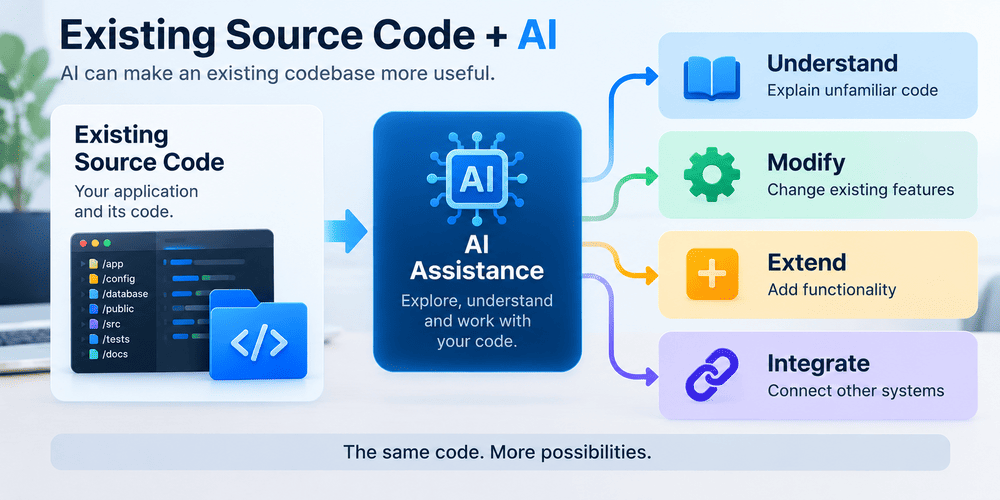
AI can help someone explore an unfamiliar codebase, explain a function, modify a component, trace a database query or adapt an existing feature.
So I am not convinced that AI simply makes source-code products obsolete.
It may change what buyers expect from them.
The value moves further away from "here are some files you don't have to type yourself" and toward "here is a coherent application you don't have to invent from the beginning."
A Screenshot Can't Tell You Whether the Product Is Good
This creates a peculiar problem when selling source code.
The easiest part to show is the least complete representation of the product.
You can show the dashboard.
You can show screenshots of reports, settings and forms. You can create a demo and let people click around the interface.
All of that is useful.
But a developer may be equally interested in things that don't photograph well.
- Is the project understandable?
- Can it be installed without archaeology?
- Are configuration values separated properly?
- Is the database sensible?
- Is the documentation useful?
- Can one part be changed without breaking three unrelated parts?
These qualities become apparent after purchase much more than before it.
That makes trust unusually important in this type of product.
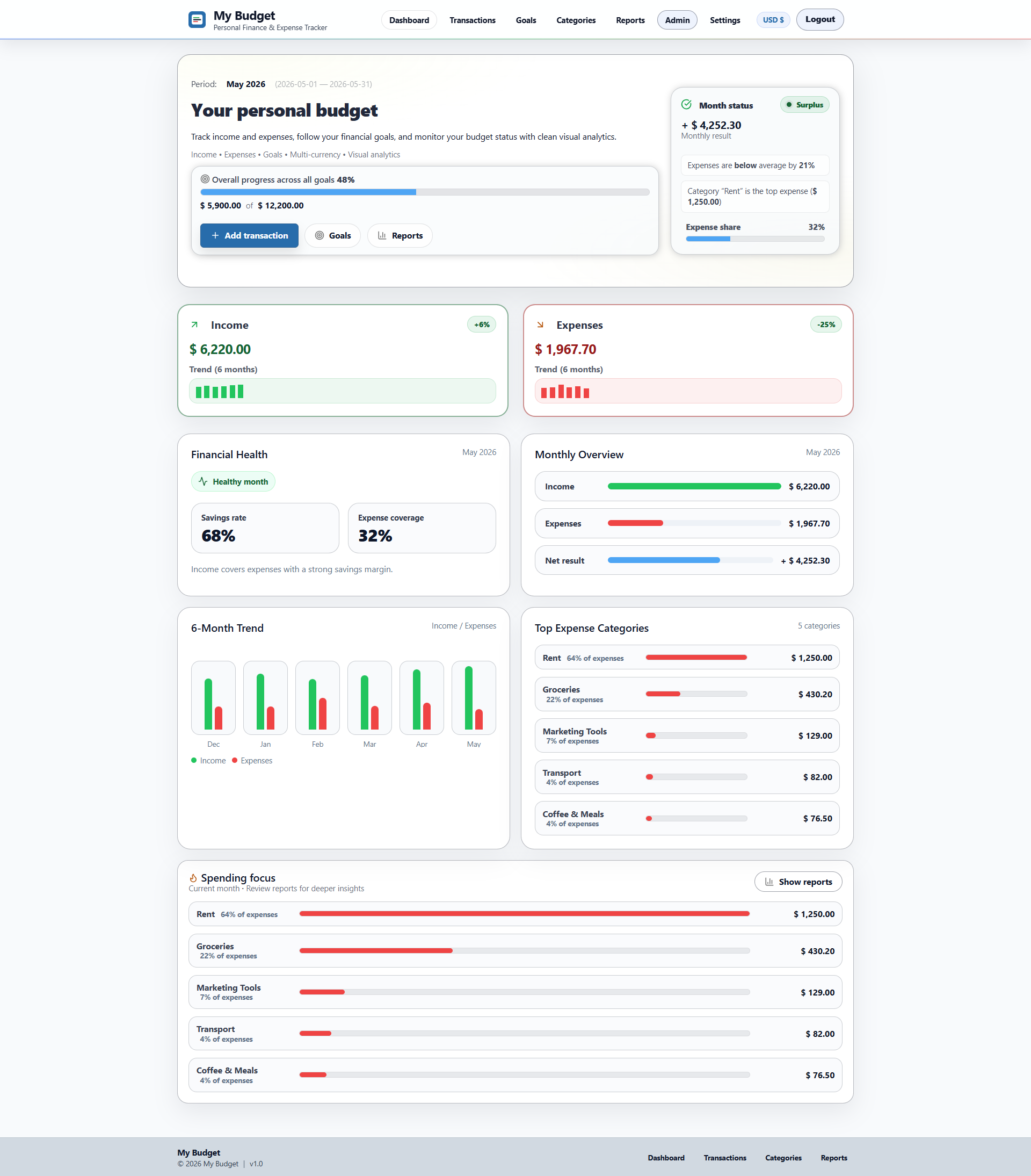
Building My Budget Made This More Obvious to Me
When I built My Budget, the application itself wasn't the only thing that eventually needed attention.
The visible product has transactions, categories, goals, reports, charts, settings and other functionality you would expect from a personal-finance application.
But if I want to distribute it as source code, another layer appears.
Someone other than me has to be able to install it.
The database can't exist only because I remember how I created it. Configuration can't depend on information sitting somewhere in my head. A demo has to behave like a demo. Documentation has to explain things I don't personally need explained.
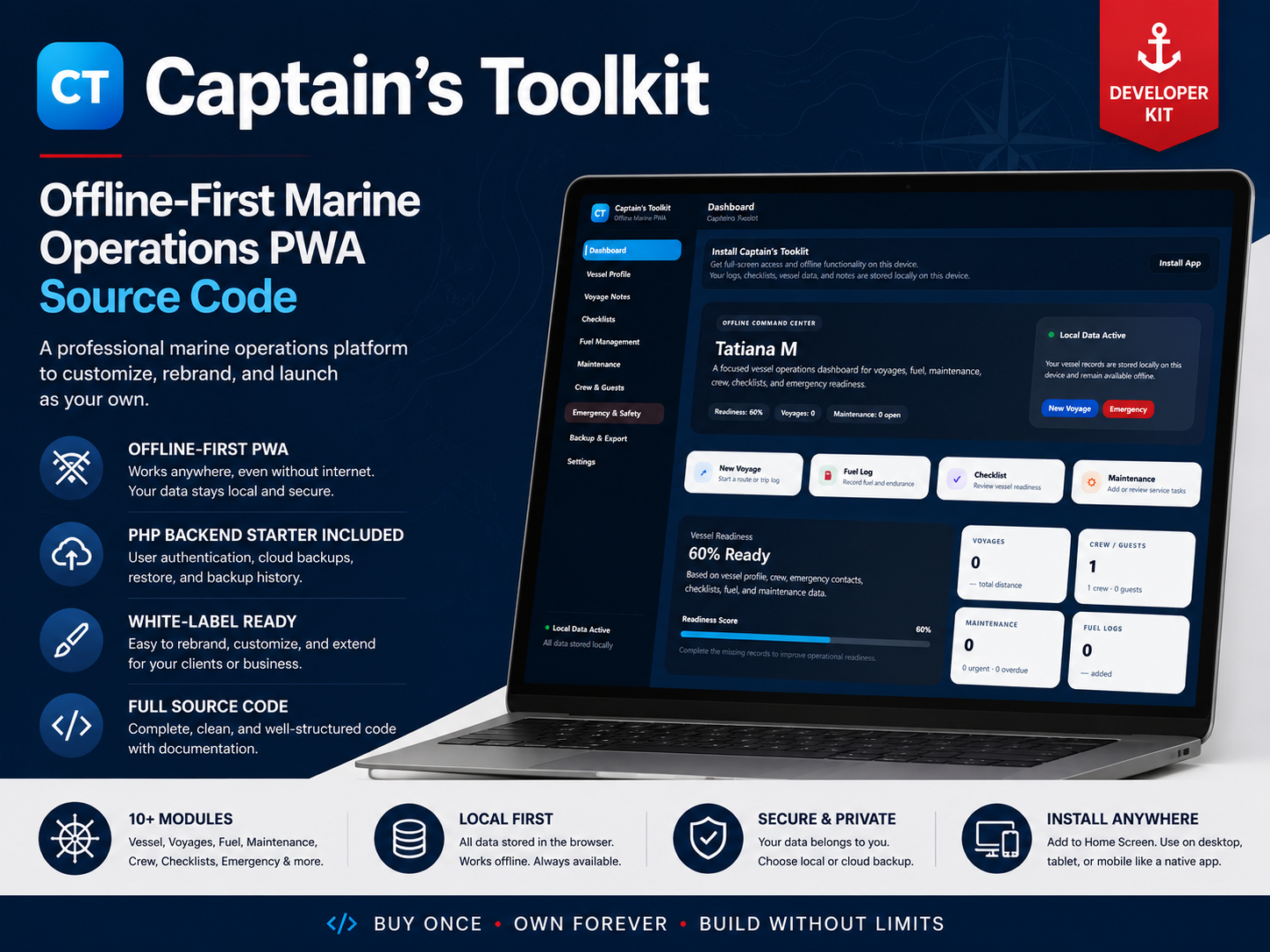
The same applies to Captain's Toolkit, even though it solves a very different problem.
That is one reason I increasingly see source-code products as something separate from simply "selling my code."
The code has to leave the environment in which it was created and survive contact with another person.
That changes how I think about finishing software.
Sometimes Buying Source Code Makes No Sense
There are also plenty of situations where this model is the wrong answer.
If someone needs a standard tool and a mature SaaS product already does exactly what they want, running their own application may create responsibility for no useful reason.
If nobody involved can maintain the code, having access to it doesn't magically create technical capability.
If an existing source-code product only vaguely resembles the required application, modifying it may cost more time than starting from a cleaner foundation.
There are projects where specific security, regulatory, scaling or integration requirements make an off-the-shelf codebase inappropriate.
And sometimes the code simply isn't very good.
Buying source code because it looks cheaper than custom development can become expensive if the next developer spends days trying to understand what the previous developer did.
There isn't a universal hierarchy where owning code is better than SaaS and custom development is better than both.
They solve different problems.
The Buyer Changes the Meaning of the Product
This brings me back to those two people downloading the same ZIP file.
Except now there might be five of them.
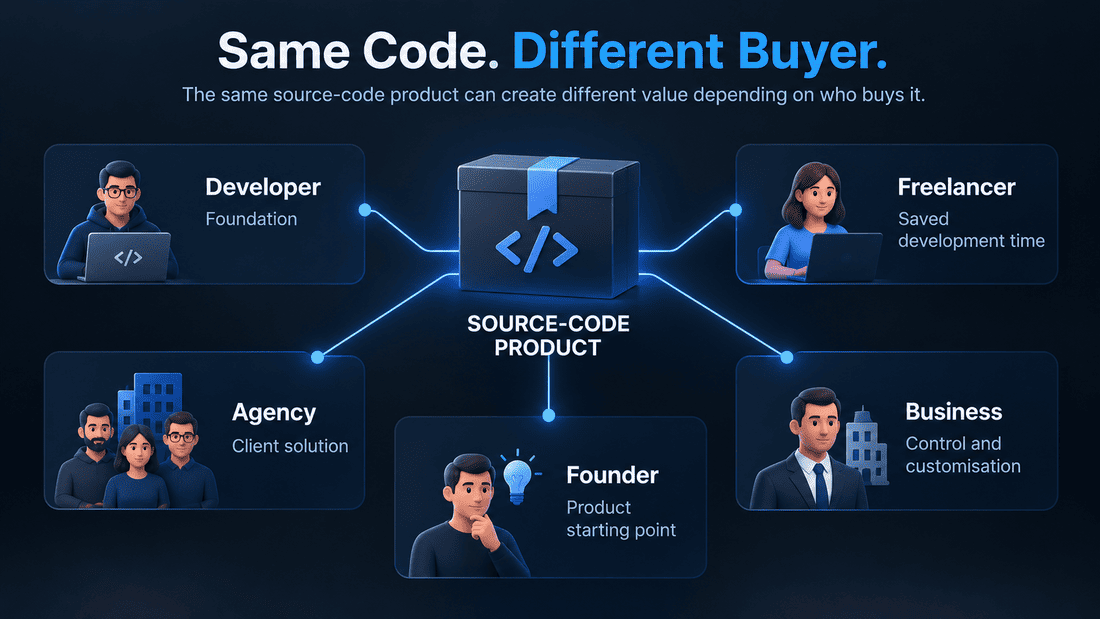
| Buyer | What They May Actually Be Buying |
|---|---|
| Developer | A foundation |
| Freelancer | Development time they may not need to repeat |
| Agency | Something that could become part of a client solution |
| Founder | A starting point for a different product |
| Business | Software it can run and control |
The files haven't changed.
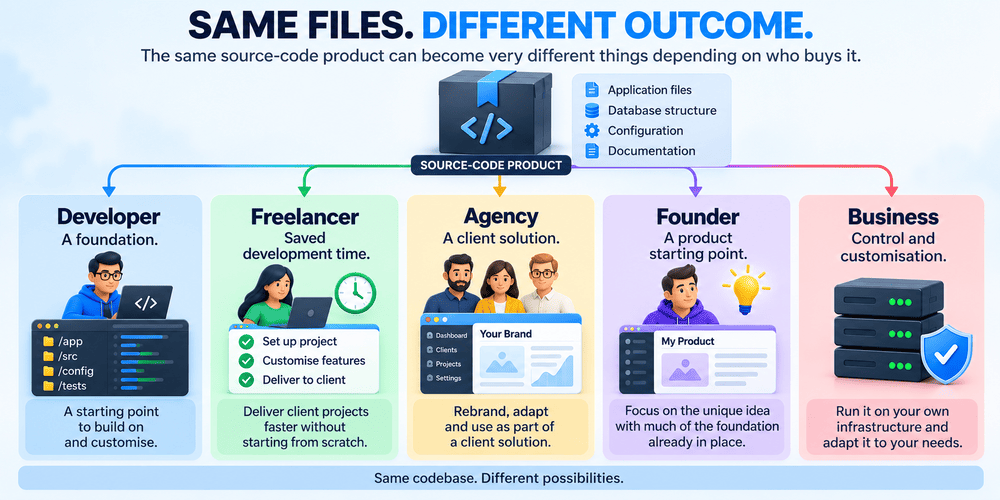
What changed is what the buyer intends to do with them.
Perhaps that's what makes source-code products difficult to describe with a normal software-product page. The product doesn't completely end at the features demonstrated in the screenshots.
Part of its value is what can happen after the purchase.
Most software says, in effect:
"Here is the tool. Use it."
A source-code product says something slightly different:
"Here is something already built."
What it becomes next may no longer be entirely up to the person who built it.