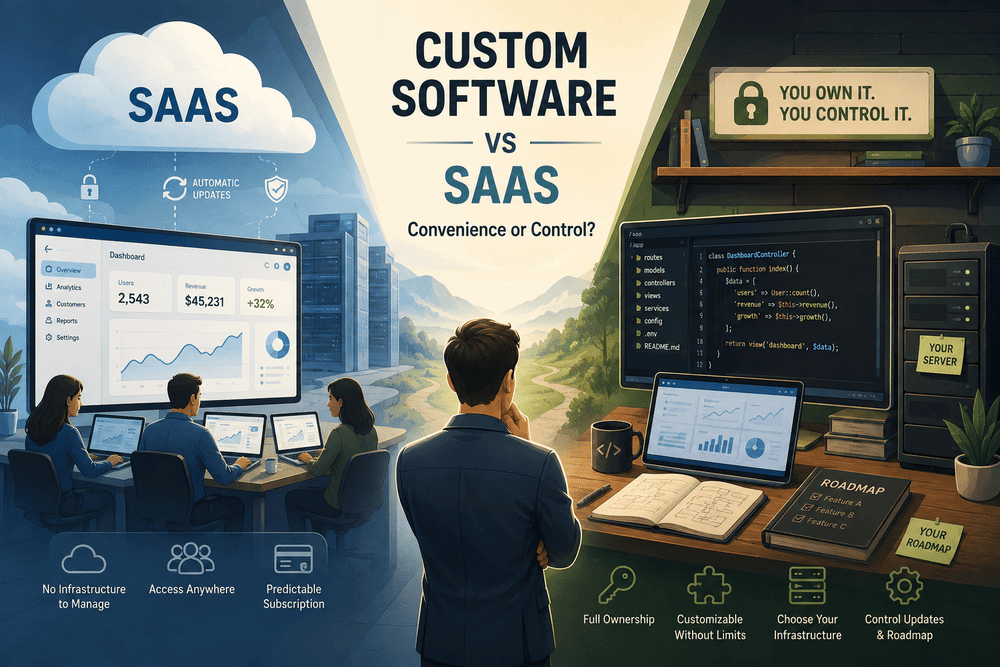
For a long time, software seemed to be moving in one direction. More applications became cloud services, subscriptions replaced perpetual licences, and almost every new business tool appeared to launch as Software as a Service (SaaS). It became so common that many people stopped asking whether there were alternatives. Choosing SaaS often felt less like a decision and more like the default.
At the same time, another part of the software industry quietly continued to exist. Companies kept investing in custom-built applications, internal business systems and self-hosted products. Some organisations even began moving certain workloads away from SaaS after years of relying on it. The result is a market where two very different approaches coexist, each solving different problems in different ways.
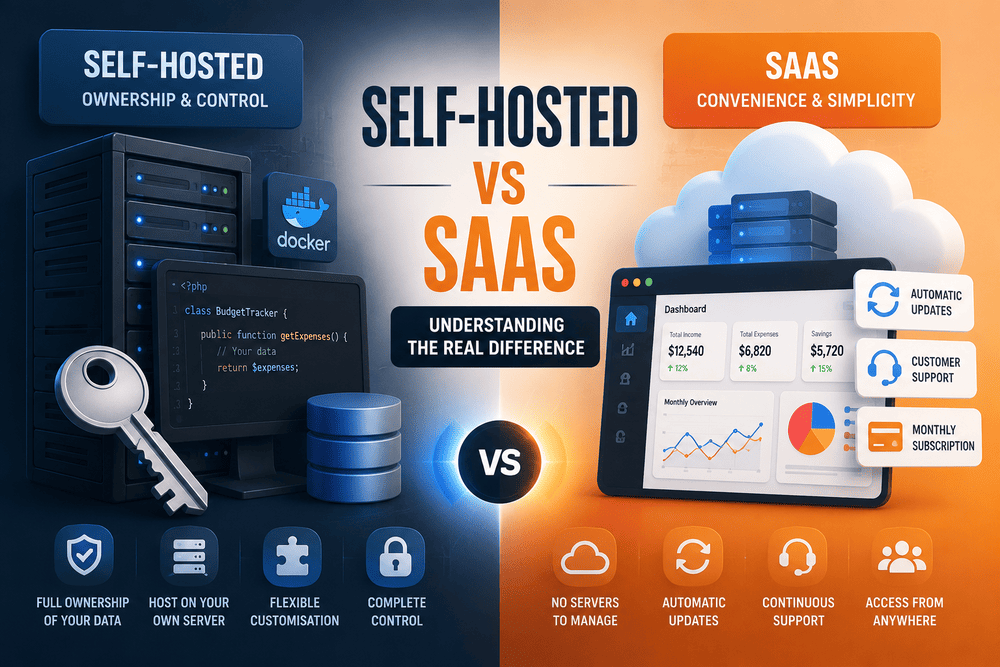
What makes the discussion interesting is that the comparison is often presented as if there were a clear winner. Advocates of SaaS point to speed, convenience and predictable updates. Supporters of custom software highlight ownership, flexibility and independence. Both perspectives contain some truth, but neither tells the whole story.
The more I worked on my own software projects, the less convinced I became that the choice could be reduced to a simple checklist of pros and cons. What initially appeared to be a technical decision gradually revealed itself as a business decision, a financial decision and, in some cases, even a philosophical one.
Choosing software is often less about technology than deciding who should control how that software evolves over the next five or ten years.
When Every Problem Started Looking Like a SaaS Opportunity
The rise of SaaS was hardly accidental. Improvements in cloud infrastructure, broadband internet and browser technologies made it possible to deliver increasingly sophisticated applications without requiring customers to install anything locally. Instead of purchasing software once and managing updates themselves, businesses could simply create an account and begin working within minutes.
This model solved many genuine problems. Vendors no longer needed to distribute installation media or support dozens of different operating systems. Customers avoided maintaining their own servers and usually received new features automatically. For smaller businesses in particular, this dramatically reduced the technical barrier to adopting professional software.
The subscription model also changed how software companies operated. Instead of relying on occasional licence sales, recurring revenue provided more predictable income that could fund continuous development and customer support. From the perspective of many software businesses, SaaS was not only a technical improvement but also a more sustainable commercial model.
SaaS simply means that the software is hosted and managed by the vendor, while customers access it over the internet through a browser or dedicated application. The provider is generally responsible for infrastructure, updates, backups and maintenance.
Because of these advantages, SaaS expanded into almost every category imaginable. Customer relationship management, accounting, marketing automation, project management, collaboration tools, design platforms and countless niche applications all embraced subscriptions. For many organisations, the convenience easily outweighed the loss of direct control.
Yet convenience is only one part of the story. As companies became increasingly dependent on external platforms, new questions slowly emerged. How easy is it to leave? What happens if pricing changes dramatically? Can the software adapt to highly specific business processes? Those questions often appear much later than the initial purchase decision.
What Do People Actually Mean by "Custom Software"?
One reason these conversations become confusing is that the term custom software can describe several very different things. Two people may use the same phrase while talking about completely different products.
In some cases, custom software refers to a completely bespoke application developed specifically for a single organisation. An agency or internal development team builds exactly what the business needs, and nobody else uses the resulting system.
Elsewhere, the phrase may describe commercial self-hosted products. These are ready-made applications sold with full source code, allowing customers to install, customise and maintain them independently. Although multiple customers may purchase the same product, each installation eventually becomes unique as businesses adapt it to their own requirements.
Open-source software adds another layer of complexity. While many open-source applications can be customised extensively, they are not necessarily built specifically for one organisation. Likewise, an internally developed reporting tool may be highly customised but never intended for commercial sale.
| Approach | Typical Characteristics |
|---|---|
| Bespoke Software | Developed specifically for one organisation and its workflows. |
| Self-Hosted Commercial Software | Purchased once, installed by the customer and fully owned after deployment. |
| Open-Source Software | Source code is publicly available and can often be modified freely under its licence. |
| SaaS | Hosted, maintained and continuously updated by the vendor through a subscription. |
Understanding these distinctions matters because many comparisons between custom software and SaaS accidentally mix together very different categories. A bespoke ERP system developed over three years cannot fairly be compared with a simple online project management service. Likewise, comparing a highly polished SaaS platform with an unfinished internal tool rarely produces meaningful conclusions.
Why I Chose a Different Direction
While building my own products, I realised fairly early that I was unlikely to build a SaaS business. Not because I disliked the model, but because it didn't fit the way I work.
I develop my projects independently while also working full-time. Running a successful SaaS product means far more than writing code. It usually involves continuous customer support, infrastructure monitoring, regular feature releases, security updates, payment systems and responding quickly whenever something stops working. For many companies this approach makes perfect sense, especially with dedicated teams behind it.
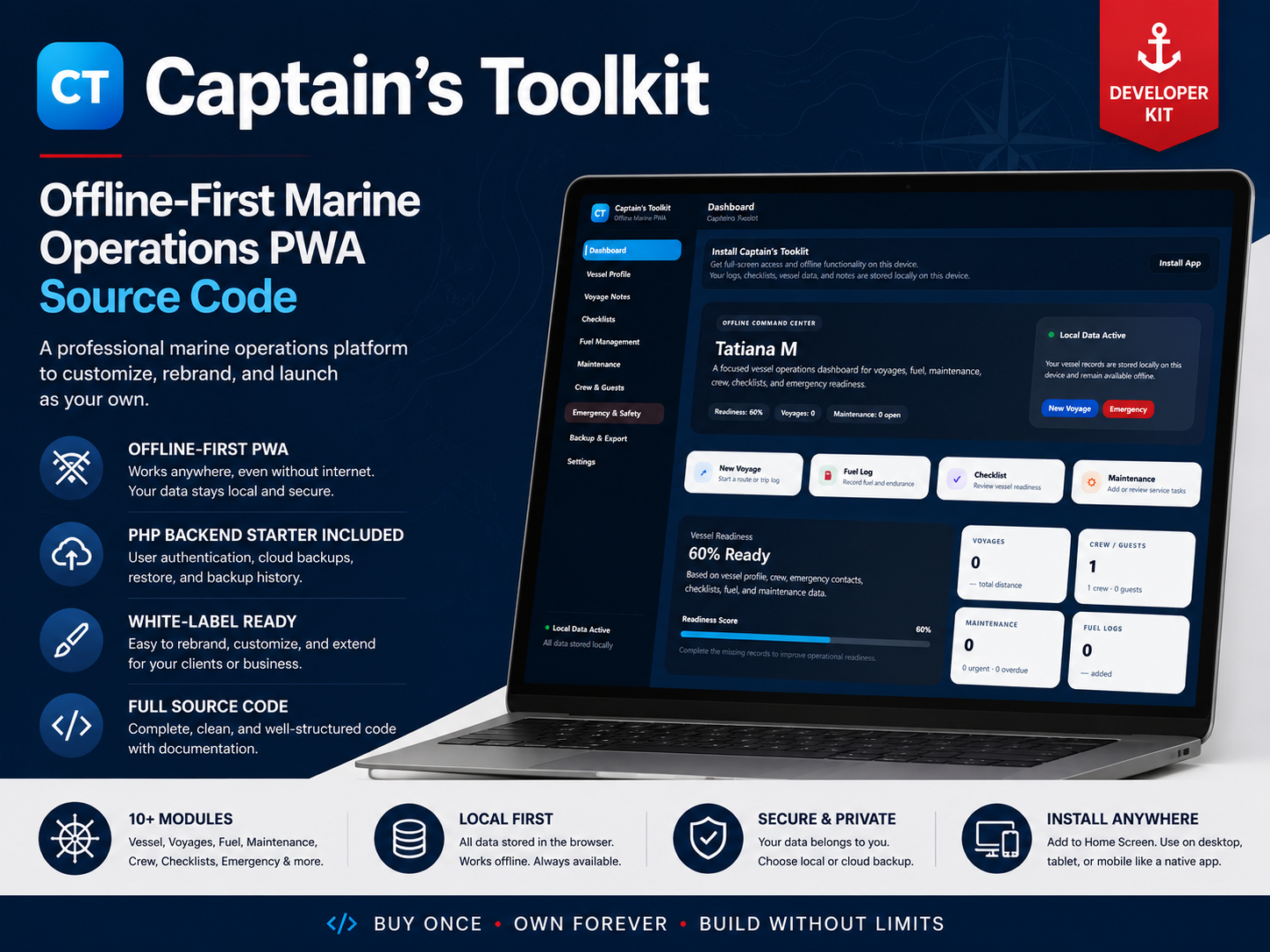
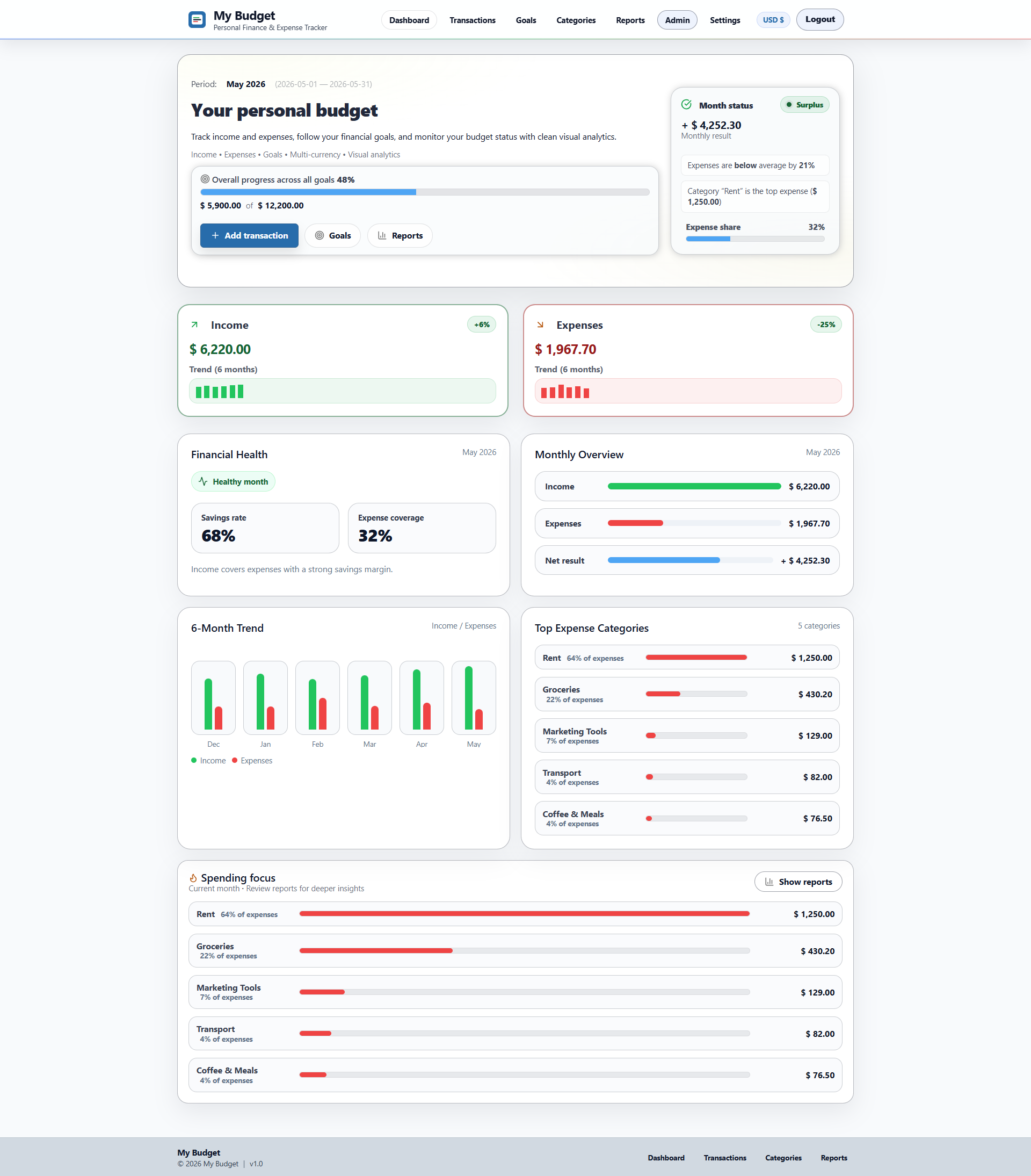
In my situation, I found myself thinking about a different question. Instead of asking how I could host software for every customer indefinitely, I started asking whether I could create products that people could truly own. That line of thinking eventually led me towards self-hosted PHP applications such as My Budget and Captain's Toolkit , and later influenced the direction of Cordinant itself.
That doesn't mean self-hosted software is automatically the better model. It simply aligns better with the kind of products I want to build and the way I can realistically support them. Someone else, with different resources and different ambitions, could reasonably reach the opposite conclusion.
The interesting question isn't whether SaaS or custom software is better. It's whether the business model behind the software matches the people building it and the people using it.
That idea kept returning as I worked on new projects. The more I explored the subject, the more I realised that ownership changes the conversation in ways that aren't immediately obvious. Once software becomes something you control rather than simply access, many familiar assumptions begin to look different. That is where the comparison becomes far more interesting.
Ownership Changes More Than You Might Expect
The word ownership appears frequently in discussions about software, but it often means different things to different people. For some, ownership simply means having access to the application's data. For others, it means possessing the source code, deciding when updates are installed and choosing where the software runs. These distinctions may seem subtle at first, yet they often shape how a business operates over many years.
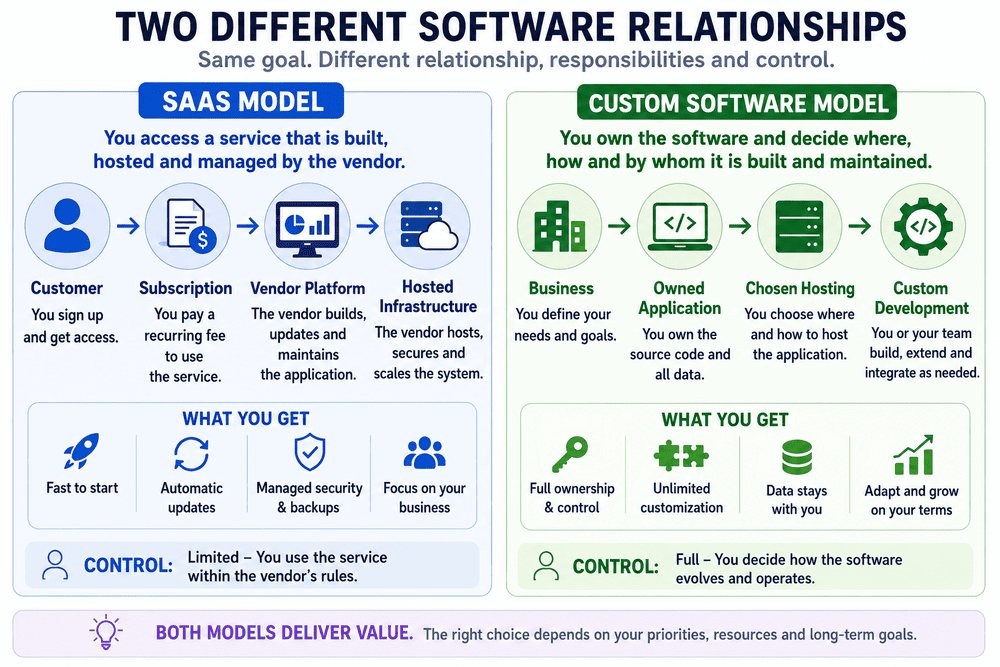
With most SaaS products, customers purchase access rather than the software itself. The provider hosts the application, manages the infrastructure, develops new features and determines when changes are introduced. This arrangement works remarkably well for many organisations because it removes a great deal of operational responsibility.
Custom software changes that relationship. Whether it is a bespoke application developed specifically for one company or a self-hosted commercial product, the customer typically has much greater control. That freedom comes with additional responsibility, but it also creates possibilities that simply do not exist when every decision depends on a vendor.
| Aspect | SaaS | Custom or Self-Hosted Software |
|---|---|---|
| Application hosting | Vendor | Customer |
| Source code access | Usually unavailable | Available to the owner |
| Updates | Controlled by vendor | Controlled by customer |
| Infrastructure | Managed service | Customer's responsibility |
| Customisation | Limited to platform capabilities | Limited mainly by budget and technical resources |
Neither approach is inherently superior. Many businesses would rather avoid maintaining servers or applying security updates themselves. Others consider long-term control worth the additional effort. The answer depends less on technology than on priorities.
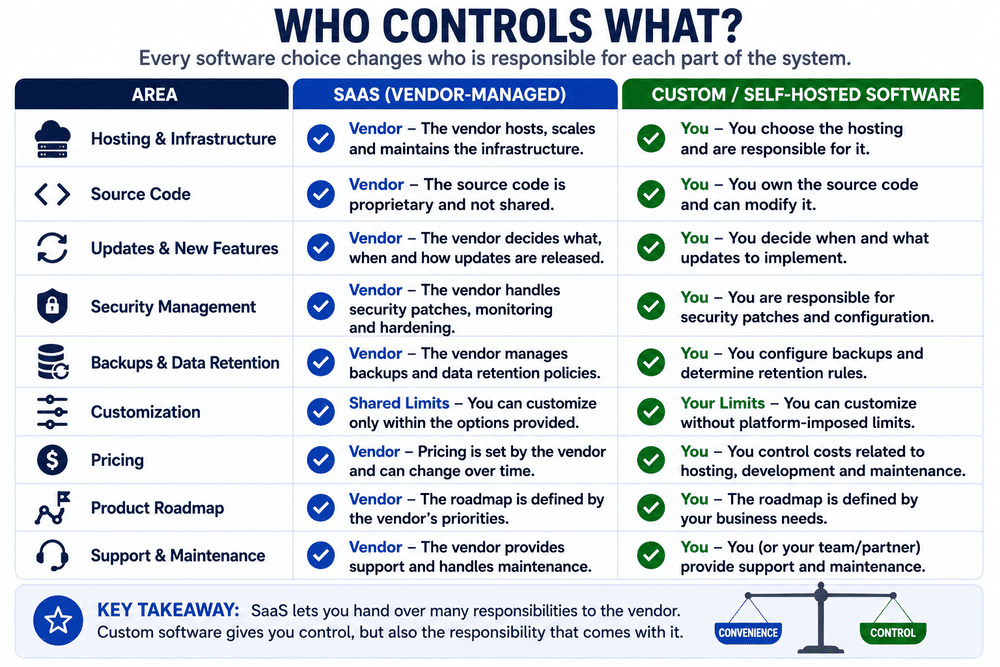
Software ownership is rarely about possessing code for its own sake. It is about deciding who controls the future of the product.
The Subscription Price Rarely Tells the Whole Story
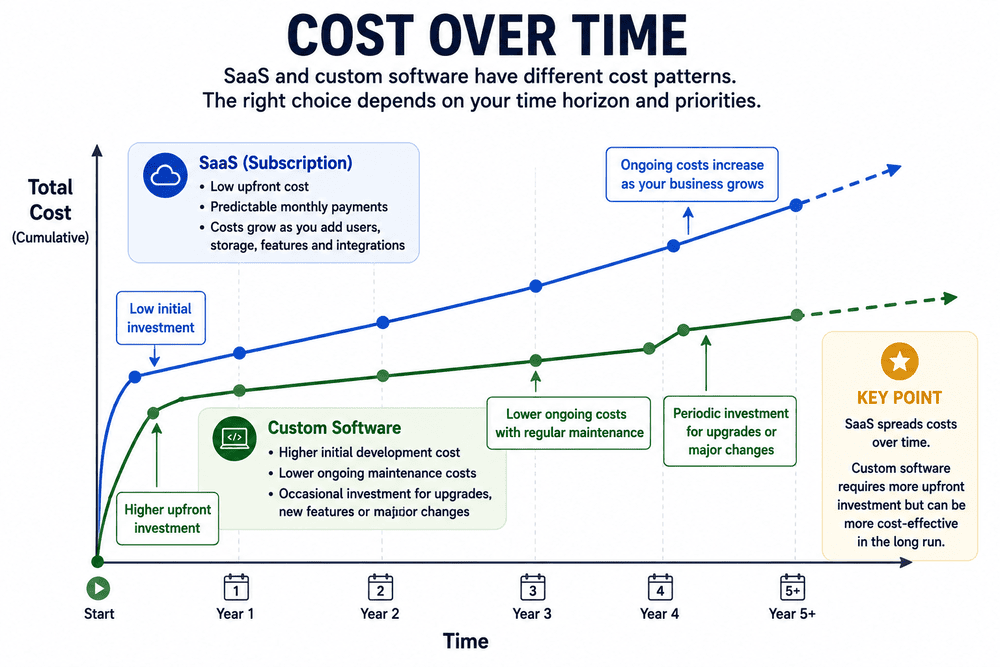
Comparing costs sounds straightforward until the time horizon becomes longer than a few months. A SaaS subscription often has a very low barrier to entry. Paying a monthly fee feels much easier than investing a significant amount upfront in a custom solution.
For startups and small businesses, this can be exactly the right decision. Instead of spending months building internal tools, they can focus on acquiring customers, validating ideas and growing revenue. In many cases, speed is far more valuable than ownership.
The picture may change over several years. As organisations grow, subscriptions often expand with them. More users, additional storage, premium integrations and enterprise features gradually increase recurring costs. Each increase may appear reasonable on its own, but together they can significantly change the overall investment.
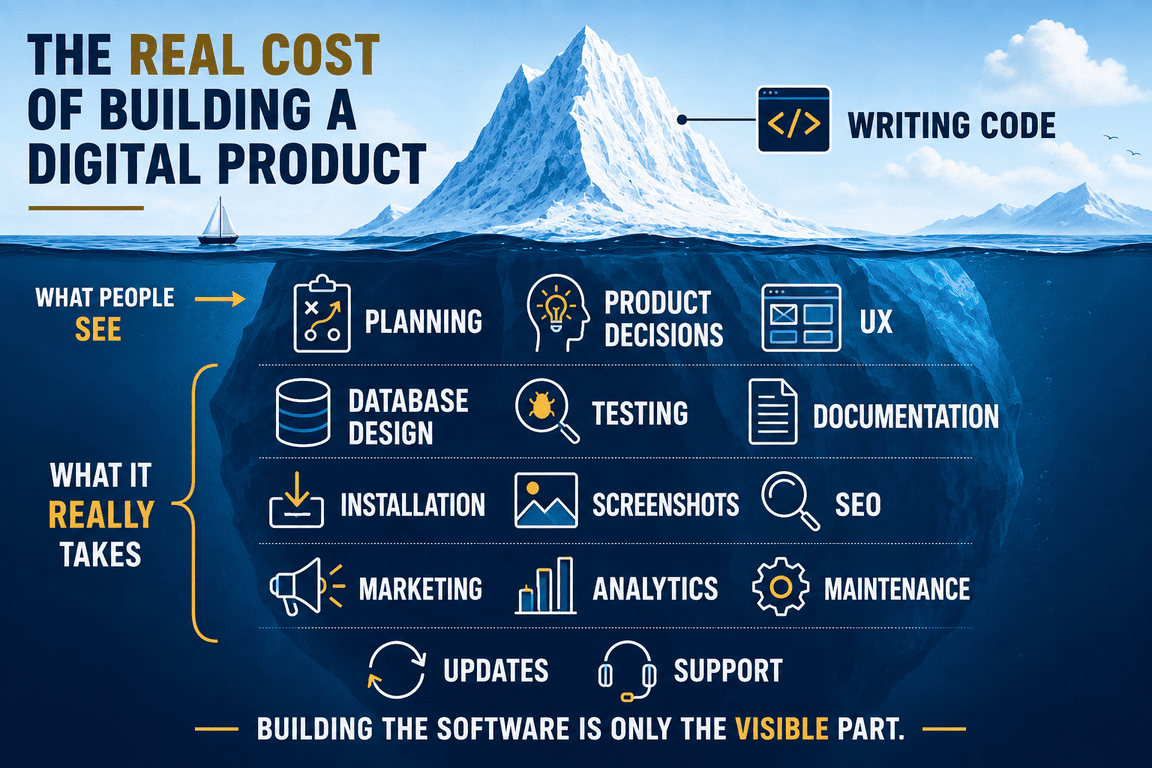
That does not automatically make custom software cheaper. Developing software requires skilled people, planning, testing, maintenance and continuous improvements. Even after launch, software is never completely finished. Bugs appear, business requirements evolve and technologies continue changing.
Comparing only the purchase price or subscription fee can be misleading. A more meaningful comparison considers the total cost of ownership over several years, including maintenance, infrastructure, support, customisation and future changes.
One of the reasons software decisions become difficult is that many of these future costs are impossible to predict accurately. A business may never outgrow its SaaS platform. Another may discover after two years that its workflows have become increasingly constrained by software originally chosen for convenience.
Flexibility Has a Price Regardless of the Model
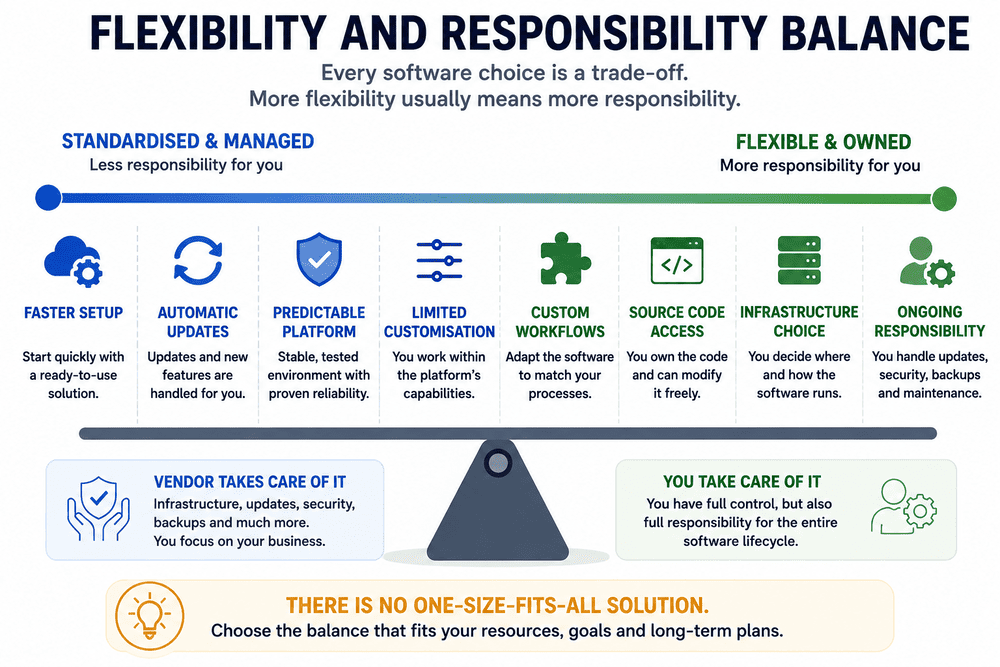
One of SaaS's greatest strengths is standardisation. Every customer uses essentially the same platform, allowing the vendor to improve one product rather than maintaining thousands of customised versions. This consistency often leads to better reliability, easier documentation and faster onboarding.
The downside is that every business eventually encounters situations where its processes differ from those anticipated by the software designers. Modern SaaS platforms often provide APIs, plugins and automation tools to bridge these gaps, but there are practical limits to how much a hosted service can be adapted without becoming impossible to maintain.
Custom software approaches the problem from the opposite direction. Instead of adapting business processes to fit existing software, the software itself can evolve around the organisation's needs. Additional modules, unique workflows and specialised integrations become possible because the underlying code belongs to the customer.
At first glance this sounds like unlimited freedom, but unlimited flexibility also means unlimited responsibility. Every new feature requires design decisions, implementation, testing and long-term maintenance. Features that initially seem small may introduce unexpected complexity elsewhere in the application.
Unlimited customisation is not automatically an advantage. Every modification increases the amount of software that someone must understand, maintain and eventually update.
I have noticed this while building my own applications. Sometimes a feature appears obvious until implementation begins. One change affects another, new edge cases emerge and what initially looked like a simple improvement becomes a much larger architectural decision. Owning the code provides enormous freedom, but it also removes the ability to blame someone else's roadmap.
Who Looks After the Software?
One question receives surprisingly little attention during software comparisons: who is actually responsible once the software is running?
With SaaS, the answer is usually straightforward. The vendor maintains the infrastructure, applies security updates, monitors availability and generally ensures the platform continues operating. Customers may occasionally experience downtime, but resolving those issues is largely someone else's responsibility.
Custom software distributes those responsibilities differently. Depending on the project, maintenance may be handled by an internal development team, an external agency, a freelancer or the original software supplier. Someone must monitor servers, install updates, fix bugs and keep the application compatible with changing technologies.
This is one of the reasons I decided not to build SaaS products myself. As an independent developer working alone, I knew that continuous hosting, infrastructure monitoring and customer support would become a substantial part of the business. I realised that I was more interested in creating software than operating an online service around the clock.
That personal decision should not be interpreted as criticism of SaaS businesses. Many companies build exceptional hosted products precisely because they have dedicated teams capable of supporting customers every day. My conclusion simply reflected my own circumstances rather than a universal rule.
Ultimately, every software model asks the same question in a different way: who carries the responsibility after the software has been delivered? The answer often matters just as much as the software itself.
Why Different Businesses Reach Different Conclusions
One reason software debates rarely reach a satisfying conclusion is that businesses rarely start from the same position. A young startup validating its first idea faces very different constraints from a manufacturing company that has refined its internal processes over twenty years. The software that feels like the obvious choice for one organisation may be completely unsuitable for another.
For many startups, SaaS offers something extremely valuable: momentum. Instead of spending months building infrastructure, teams can focus on customers, products and revenue. Email marketing, accounting, customer support and project management can all be operational within a single afternoon. That speed is often worth far more than complete ownership.
Established businesses sometimes approach the problem differently. Years of experience often produce workflows that no generic application fully supports. Employees develop processes around the business rather than around the software, making customisation increasingly valuable. At that point, adapting the software may become easier than asking hundreds of people to change the way they work.
Highly regulated industries introduce another perspective. Healthcare providers, financial institutions, government organisations and companies handling sensitive information may place greater emphasis on data control, compliance and infrastructure decisions than organisations operating in less regulated environments. In these situations, software architecture becomes closely connected to legal and operational requirements rather than convenience alone.
| Business Situation | Common Direction | Reasoning |
|---|---|---|
| Early-stage startup | SaaS | Launch quickly and minimise initial costs. |
| Growing agency | Hybrid | Combine commercial tools with custom internal systems. |
| Large enterprise | Mixed ecosystem | Different departments require different solutions. |
| Regulated industry | Custom or self-hosted | Greater control over infrastructure and data. |
| Specialised niche business | Custom software | Unique workflows often exceed SaaS capabilities. |
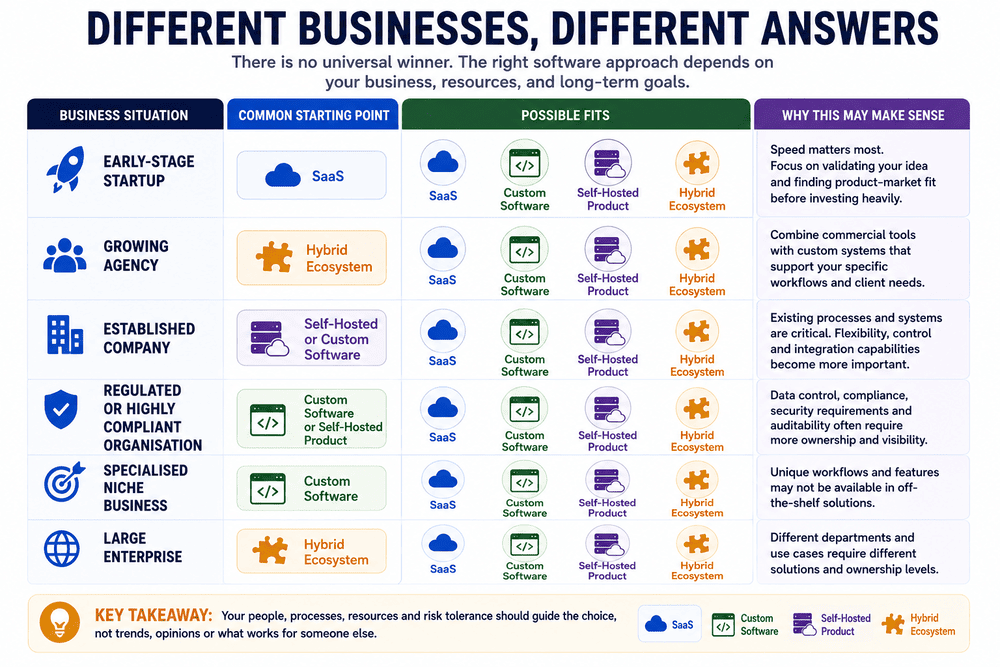
Perhaps the most interesting observation is that successful companies exist in every category. Some build their operations almost entirely around SaaS platforms. Others invest heavily in proprietary systems. Many combine both approaches without seeing them as competitors at all.
Why Some Companies Eventually Move Away from SaaS
The decision to leave a SaaS platform is rarely emotional. More often it develops gradually as a business grows and discovers that yesterday's convenient solution no longer fits today's requirements.
Recurring costs are one possible reason. A subscription that felt insignificant with five employees may become a substantial operational expense when the organisation has hundreds of users. The software itself may not have become worse, but the economics have changed.
Other companies reach different limitations. They may require integrations that are unavailable, workflows that cannot be customised or reporting capabilities that extend beyond the vendor's roadmap. In these situations, businesses are not necessarily dissatisfied with the platform, they have simply outgrown the assumptions on which it was designed.
Vendor dependency also becomes a consideration over time. Subscription prices change. Features appear and disappear. Entire products are occasionally discontinued or acquired by other companies with different priorities. Most software vendors act responsibly, but businesses that depend heavily on a single platform inevitably place part of their future in someone else's hands.
Leaving a SaaS platform does not automatically mean replacing it with fully custom software. Many organisations simply move to another hosted service or adopt a combination of commercial and internally developed tools.
None of these observations suggest that SaaS is a temporary solution or an inferior model. They simply illustrate that business needs continue evolving long after the original purchasing decision has been made.
Perhaps the Future Isn't Either-Or
One assumption quietly running through many online discussions is that businesses must choose between SaaS and custom software as if they were mutually exclusive. Looking at how many organisations actually operate suggests something rather different.
A company might use cloud accounting software, host its own customer portal, build a custom internal dashboard, rely on a commercial email platform and integrate several AI services through external APIs. None of these decisions contradict one another. Together they simply reflect different priorities for different parts of the business.
This hybrid approach appears increasingly common because modern software ecosystems are designed to connect. APIs, webhooks and integration platforms allow organisations to combine specialised tools instead of forcing every requirement into a single application.
Ironically, the debate between custom software and SaaS may be becoming less relevant precisely because businesses no longer expect one solution to solve every problem. Instead, they assemble ecosystems where each application contributes something different.
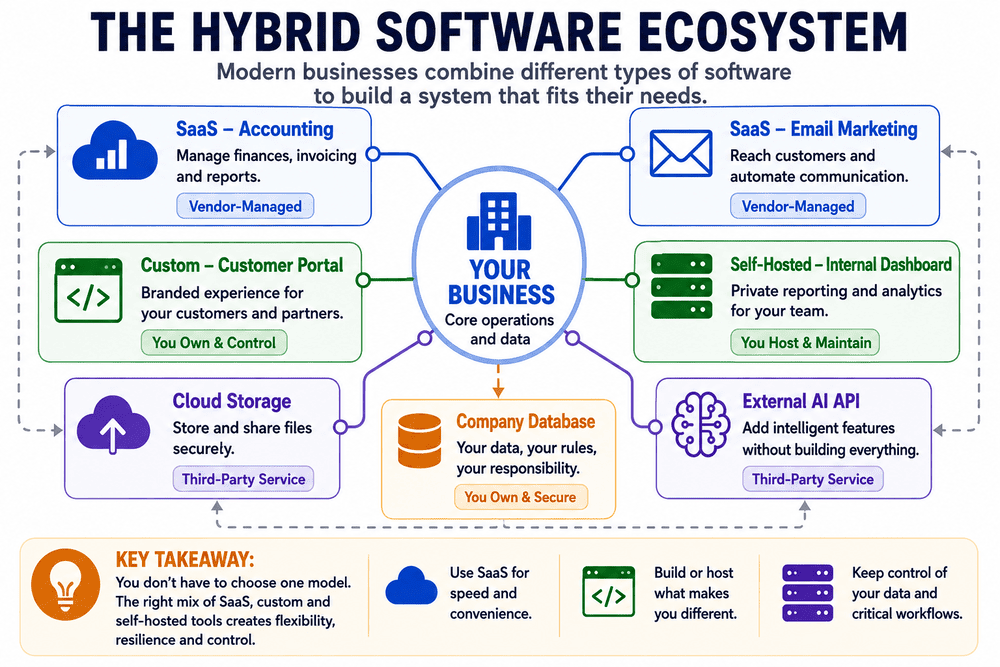
The most successful software strategy may not be choosing one model over another. It may be knowing which parts of the business benefit from ownership and which benefit from convenience.
Looking Back at the Question
When I first started thinking about software ownership, I assumed the discussion would revolve around technology. As I worked on my own projects, that assumption slowly changed. The technical differences certainly matter, but they are often easier to solve than the business questions behind them.
Building self-hosted applications suited the kind of products I wanted to create and the way I wanted to work. Another independent developer might reasonably reach a different conclusion and build an excellent SaaS business instead. Neither choice automatically reflects better engineering or stronger business judgement.
The more interesting question is whether the software model supports the people behind it. Does it fit the team's resources? Does it align with customer expectations? Can it still make sense five years from now rather than only next month?
Perhaps that is why the comparison between custom software and SaaS continues to generate debate. Both approaches have proved themselves. Both continue evolving. And both are likely to remain important for a long time, not because one will eventually replace the other, but because businesses themselves are far too diverse for a single answer to fit everyone.