When people look at a finished product, they usually see the interface.
They see the dashboard.
They see the screenshots.
They see the landing page.
What they don't see is the long list of decisions, mistakes, rewrites, abandoned ideas, and moments when you wonder whether you're making progress at all.
Over the last few years I've worked on several personal projects, including a finance application, a marine operations toolkit, and my own marketplace website for selling software products.
I work alone.
There is no design team.
No backend team.
No product manager.
No marketing department.
Every decision eventually lands on my desk.
Looking back, the biggest challenges were rarely technical. Most came from uncertainty, decision-making, and trying to figure out what actually mattered.
Here are the lessons that took me the longest to learn.
Underestimating How Big a Product Really Is
The first mistake I made repeatedly was assuming that a product was mostly about its core feature.
For example, when I started building My Budget, I initially thought:
"I need transactions, categories, reports, and a dashboard."
That sounded manageable.
What I failed to account for was everything surrounding those features:
- Authentication
- Password recovery
- User settings
- Database migrations
- CSV exports
- Mobile responsiveness
- Validation
- Error handling
- Installation
- Documentation
- Licensing
- Product pages
- Screenshots
- Demo environments
The finance features themselves became only part of the project.
The surrounding infrastructure eventually consumed more time than the core functionality.
| Expectation | Reality |
|---|---|
| Build a finance application. | Build a finance application plus an entire ecosystem around it. |
One lesson I learned is that every feature creates additional work elsewhere.
Adding a simple reporting section doesn't just mean writing report logic.
It means updating navigation, permissions, exports, documentation, screenshots, testing, and sometimes database structures.
The feature itself is often the cheapest part.
Feature Creep and the Difficulty of Saying No
Feature creep is easy to recognize when it happens to someone else.
It's much harder when it happens to your own projects.
Every new idea feels reasonable.
While building My Budget, I frequently thought:
"It would only take another day."
Then:
"It would be useful if users could also do this."
Then:
"Since I'm already changing that section, I might as well add this too."
The problem is that these decisions accumulate.
One additional feature is harmless.
Twenty additional features can delay a launch by months.
One example was reporting.
Originally I planned a simple monthly summary.
Later I added:
- Category breakdowns
- Trend charts
- Savings metrics
- Export functionality
- Additional filtering
Some additions improved the product.
Others simply made the project larger.
What surprised me most was discovering that deciding what NOT to build is often harder than deciding what to build.
Every feature has an opportunity cost.
Time spent on one improvement is time not spent launching.
| Expectation | Reality |
|---|---|
| More features automatically create a better product. | More features often create a slower product development process. |
Today I ask a much simpler question:
"Would somebody refuse to buy this product because this feature is missing?"
If the answer is no, the feature usually moves to a future version.
Spending Too Much Time Improving Things Nobody Asked For
This one was painful.
I enjoy design work.
I enjoy refining layouts.
I enjoy polishing interfaces.
Unfortunately, that can become a trap.
There were days where I spent hours adjusting:
- Card spacing
- Typography
- Button alignment
- Color variations
- Dashboard layouts
At the end of those days, the product looked slightly better.
But it wasn't significantly more valuable.
One challenge of working alone is that nobody stops you.
Nobody says:
"This is good enough."
You can continue improving forever.
I rewrote several screens multiple times because I convinced myself they weren't finished.
Months later I realized users would probably never notice most of those changes.
The difficult lesson was learning the difference between:
- Improving a product
- Entertaining myself by refining a product
Those are not always the same thing.
Today I still care about design, but I try to focus on improvements that affect usability rather than aesthetics alone.
Documentation, Installation, and Deployment Took Longer Than Development
This was probably the biggest surprise.
As a developer, I naturally focused on building features.
I assumed documentation would be a quick final step.
I was wrong.
For products that other people install themselves, documentation becomes part of the product.
Not an accessory.
The documentation for My Budget eventually included:
- Installation instructions
- Server requirements
- Database setup
- SMTP configuration
- User management
- Deployment guidance
- Licensing information
Then came installer development.
Then compatibility testing.
Then troubleshooting hosting environments.
I discovered that shared hosting environments behave differently.
Server configurations vary.
PHP settings vary.
Permissions vary.
Mail configurations vary.
Things that worked perfectly on my machine sometimes failed elsewhere.
One database decision even forced me to revisit parts of the application architecture later because I realized future extensibility would be limited.
At the time it seemed like a small shortcut.
Months later it became technical debt.
This experience completely changed how I estimate projects.
Now I assume that deployment and documentation will require far more time than I initially expected.
Because they usually do.
Building Without an Audience and Learning to Launch Anyway
This challenge is still ongoing.
Many creators assume the difficult part is building.
For me, building was often easier than marketing.
You can spend months creating a product.
Then launch it and discover that nobody knows it exists.
That realization can be uncomfortable.
When I started building products, I didn't have:
- A large audience
- An email list
- A YouTube channel
- Thousands of followers
I assumed that launching a good product would naturally attract attention.
Reality was different.
People can't buy products they never discover.
This forced me to learn skills I originally wasn't interested in:
- Writing
- SEO
- Product positioning
- Landing pages
- Community participation
- Documentation-based marketing
Another surprise was pricing.
I spent far more time thinking about pricing than I expected.
Questions such as:
- Is this too expensive?
- Is this too cheap?
- Should I offer multiple licenses?
- What would a developer realistically pay?
There were no obvious answers.
Most pricing decisions felt uncertain.
Even today I view pricing as an experiment rather than a solved problem.
Perhaps the hardest lesson was learning when to stop improving and launch.
Every project reaches a point where improvements become increasingly small.
At some stage, more development becomes a form of procrastination.
Launching creates the possibility of feedback.
Not launching creates only more assumptions.
That distinction took me a long time to understand.
Lessons Learned
Scope expands faster than expected
Every feature creates secondary work.
Plan for the surrounding ecosystem, not just the feature itself.
Feature selection matters more than feature quantity
A smaller product that solves one problem well is often better than a larger product that tries to solve everything.
Documentation is part of the product
If users cannot install or understand your software, the quality of the code becomes irrelevant.
Marketing cannot be postponed forever
Building and marketing are not separate phases.
They need to happen together.
Good enough is usually better than perfect
Many improvements deliver far less value than expected.
Shipping often teaches more than refining.
What I Would Do Differently Today
If I started another product tomorrow, I would make several changes.
First, I would define stricter feature boundaries before writing code.
Second, I would start marketing earlier.
Not after launch.
During development.
Third, I would spend more time validating whether people actually want a feature before building it.
Fourth, I would design installation, documentation, and deployment workflows from the beginning instead of treating them as final tasks.
Finally, I would launch sooner.
Not because unfinished products are good.
But because feedback is more valuable than speculation.
Many of my biggest insights only appeared after I had something real to show people.
Try this code base
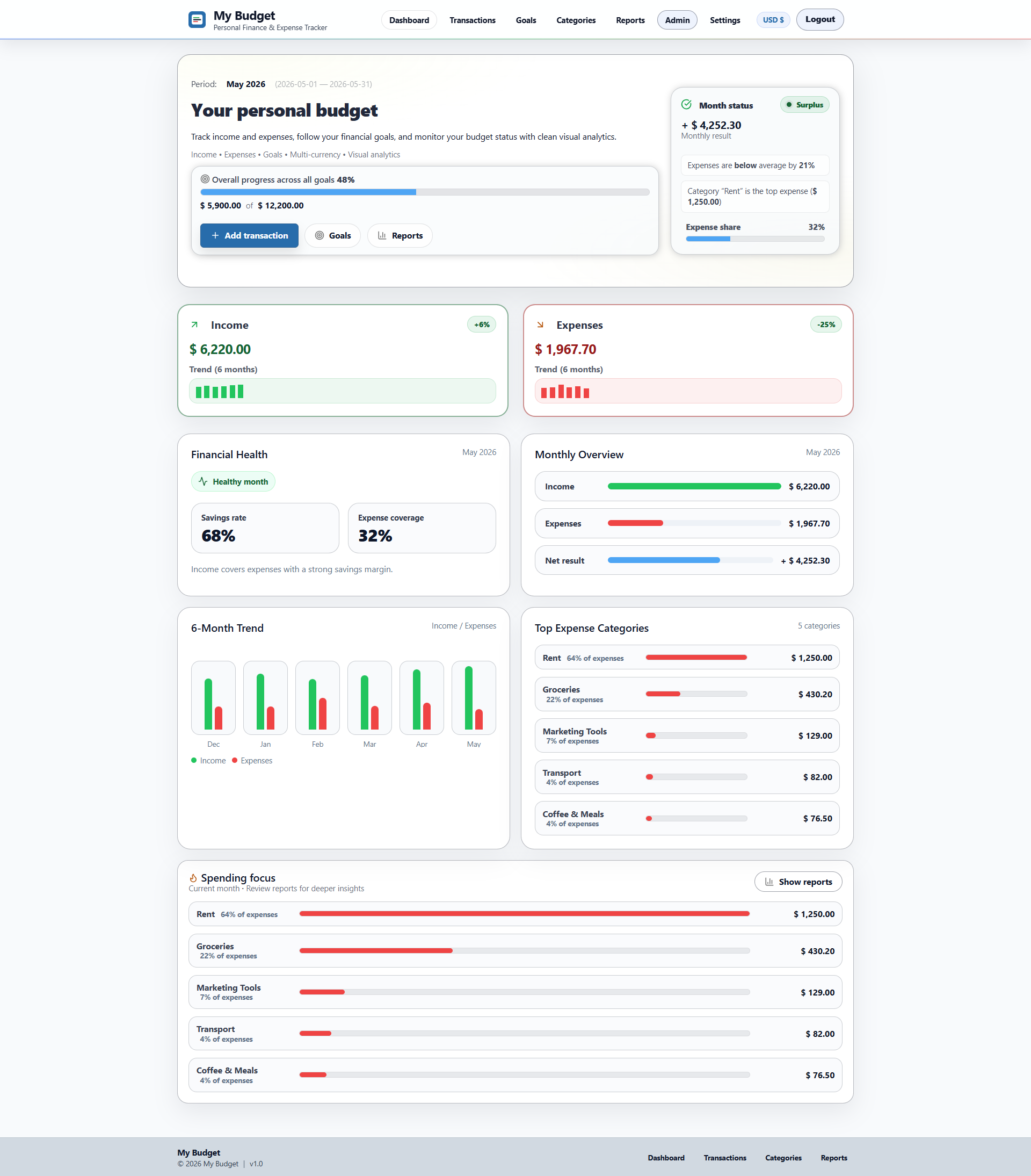
A self-hosted PHP and MySQL personal finance application with transactions, financial dashboards, savings goals, reports, CSV export and full source code.
- Everything Needed for a Modern Finance Application
- Dashboard Analytics
- Visual overview of financial activity and trends.
- Transactions Management
Key Takeaways
- Most projects are larger than they appear at the beginning.
- Feature creep rarely feels dangerous while it's happening.
- Documentation often takes longer than expected.
- Marketing is harder than many developers anticipate.
- Pricing is usually uncertain, even after launch.
- AI can accelerate development, but it doesn't eliminate product decisions.
- The ability to stop building is often as important as the ability to build.
- Launching creates learning opportunities that endless refinement never will.
Conclusion
The biggest surprise I encountered while building digital products was that technical problems were rarely the hardest part.
Databases can be redesigned.
Interfaces can be rewritten.
Code can be refactored.
The more difficult challenges involved decisions, priorities, uncertainty, and knowing when something was good enough.
I still make many of the same mistakes.
I still underestimate scope.
I still occasionally spend too much time refining details.
I still change my mind about features.
But each project has made those mistakes easier to recognize.
And that's probably the most realistic version of progress I've found so far.
Not becoming someone who never makes mistakes.
Becoming someone who notices them sooner.